After the Bid: What Happens Between Supplier Selection and the First Purchase Order?
Explore what happens after supplier selection and how contractors can manage contracts, submittals, approvals, and purchase orders without losing schedule certainty.
 Sneha Kumari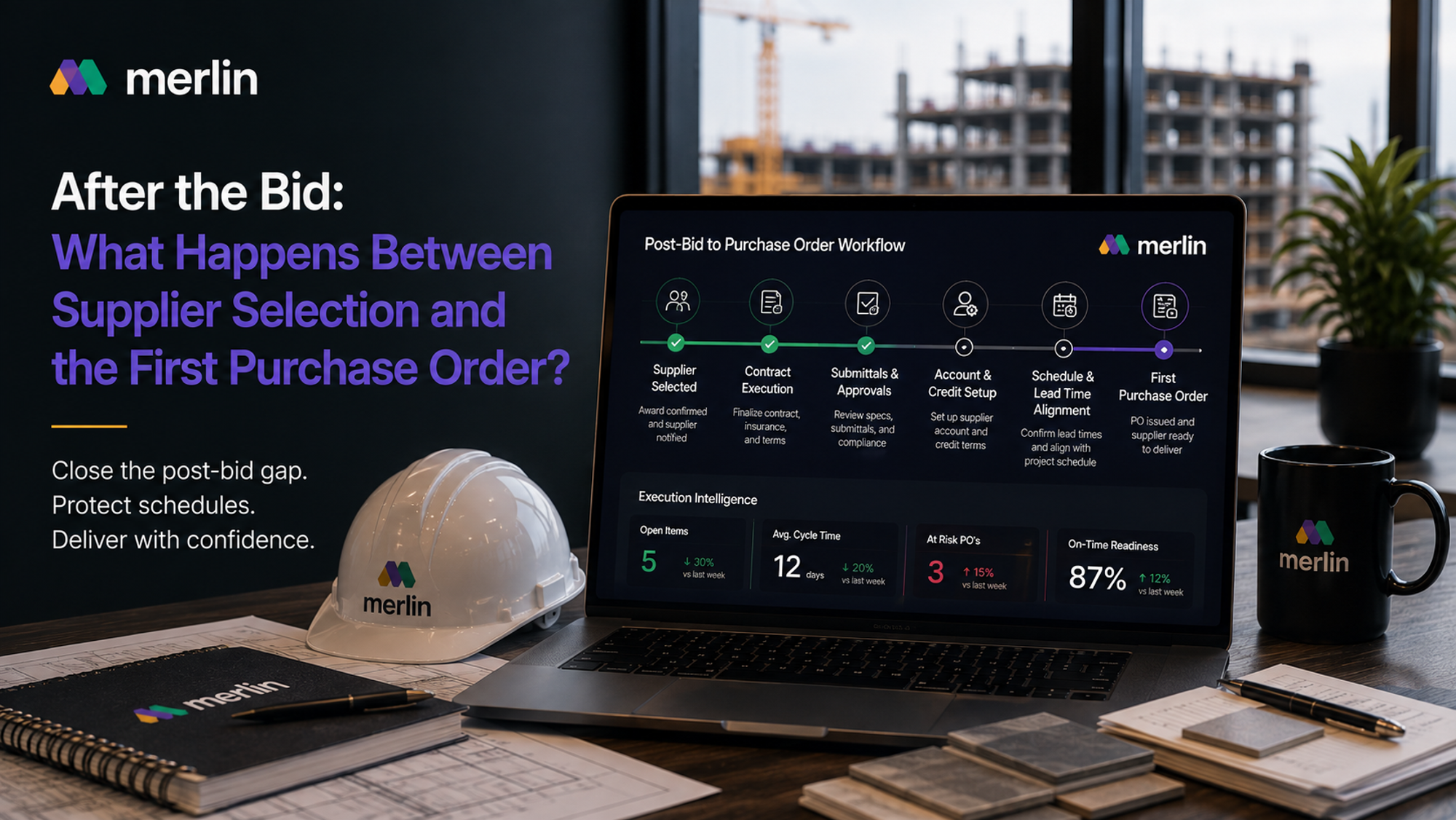
Construction procurement teams spend enormous energy getting supplier selection right: comparing bids, checking qualifications, negotiating terms. Then the award goes out, everyone exhales, and the project moves on to the next fire. What often goes unmanaged is everything that happens next: the contract execution, the submittal checks, the credit setup, the schedule alignment, all the small steps standing between "supplier selected" and a purchase order the supplier can actually act on.
That gap is where a surprising amount of construction procurement risk actually lives. A supplier who won the bid three weeks ago but has no confirmed purchase order is not a done deal, they are an open question sitting somewhere between an accounting queue and a forgotten email thread, and every day that question stays open is a day closer to a missed material date on site.
This article looks at what actually happens between supplier selection and the first purchase order, why static, disconnected procurement processes let that gap widen, and how real time procurement orchestration, backed by AI procurement management, closes it. Whether the goal is protecting the schedule certainty a competitive bid promised or giving suppliers the visibility they need to plan production with confidence, the post bid period deserves the same rigor as the bid itself.
Bridging the Critical Gap from Supplier Selection to the First Purchase Order with Active Orchestration
Supplier selection feels like the finish line. The bids are compared, the scorecard is filled in, the award email goes out, and the procurement team moves on to the next package. In practice, selection is the starting line for a separate phase of work that rarely gets a name, let alone a process: everything that has to happen before the first purchase order can actually be issued.
That phase includes contract execution and insurance certificates, submittal and spec confirmation against what was actually priced, credit terms and account setup with the new supplier, lead time confirmation against the project schedule, and the internal handoff from the team that ran the bid to the team that will manage delivery. None of this is glamorous. All of it is where post bid procurement actually breaks down, and all of it is properly part of the purchase order process, even though most teams only start thinking of it that way once the order is already late.
The reason it breaks down is structural, not personal. Supplier selection typically lives in a bidding tool or a spreadsheet. The purchase order lives in an accounting system or an ERP. The submittal review lives in email threads. The schedule lives somewhere else entirely. Every handoff between these systems is a place where information gets rekeyed, forgotten, or simply goes stale, and every stale handoff adds days to the gap between award and PO. It is the same coordination pattern behind why so many construction projects run behind schedule in the first place: rarely one dramatic mistake, almost always a series of small handoffs nobody was tracking.
Active orchestration means treating that gap as a tracked, owned process rather than an assumed one. Instead of asking "did we award the bid," the question becomes "what specifically stands between this award and a purchase order the supplier can act on, and who owns closing each item." That reframing is the difference between procurement management that reacts to delay and one that prevents it.
How Operational Intelligence Keeps Manufacturers and Suppliers Connected to Real Time Production
Once a supplier is selected, the project does not stop moving. Schedules shift, quantities get revised, phases get resequenced, and the production plan the estimator priced against on day one is rarely the plan that exists three weeks later when the purchase order finally goes out. Static procurement processes assume the world holds still between selection and order. Operational intelligence assumes it does not.
The practical difference shows up in how information travels. In a static process, a schedule change made by the project team has no automatic path to the supplier or the purchasing desk. Someone has to notice it, remember the pending award, and manually flag that quantities or dates need revisiting. In an operationally intelligent system, the purchase order in progress is linked to the live schedule and the live scope, so a change on one side surfaces automatically on the other.
This matters most for manufacturers and fabricators working from a production queue. A contractor who has selected a supplier but not yet issued a purchase order is, from the supplier's side, an unconfirmed slot in their production schedule. The longer that slot stays unconfirmed, the harder it becomes to guarantee the lead time that made the bid competitive in the first place. Keeping suppliers connected to real time production data, rather than to a single point in time bid, protects the schedule assumptions both sides made when the contract was signed.
This is also where construction software built around materials, labour, and cost earns its value over generic project management tools. A system that treats procurement as one more static task list cannot show a supplier how their commitment connects to what is actually happening on site this week. A system built for production intelligence can.
Why Suppliers Need a Real Time Execution Layer to Align Materials and Decisions After the Bid
Most of the coordination that happens after a bid is won still runs through phone calls, forwarded emails, and PDF attachments passed back and forth until someone loses track of the latest version. Suppliers are asked to hold pricing, hold capacity, and hold materials based on a verbal or written award, often for weeks, without any system of record confirming what has actually been agreed and what is still in motion.
This is a real cost, not just an inconvenience. A supplier holding capacity against an unconfirmed order is making a bet on that project completing its internal process on time. When it does not, the supplier either eats the cost of idle capacity or quietly deprioritizes the order behind customers with confirmed purchase orders in hand, which is exactly the outcome the buyer was trying to avoid by locking in supplier selection early.
A real time execution layer changes what the supplier sees, and it is what modern supplier management actually looks like in practice. Instead of a single award notification followed by silence, the supplier has visibility into where the order sits in the buyer's internal process: contract review, submittal confirmation, credit setup, or final release. That visibility lets the supplier plan production and allocate materials with actual information rather than assumptions, and it gives the buyer a channel to flag delays before they compound into a missed delivery window.
For suppliers trying to build a more predictable pipeline of construction work, this kind of visibility is often more valuable than the bid itself. Building a steady flow of RFQs without relying on cold outreach only pays off if the orders that follow those RFQs move through to a confirmed purchase order fast enough to plan around, which is precisely the layer most procurement processes are missing.
Using AI to Manage Procurement Complexity and Ensure Materials Arrive on Time
The work between selection and purchase order is repetitive, rule based, and heavy on cross referencing, which makes it a natural fit for AI procurement management rather than manual review. For contractors running several active projects at once, material procurement risk compounds fastest in exactly this window, since a delay on one order rarely stays isolated once it starts pushing against shared schedules and shared crews. Confirming that a submittal matches the priced scope, checking a supplier's lead time against the current schedule, and flagging a credit hold before it stalls an order are all tasks that follow a consistent pattern every time, even though the specific numbers change project to project.
AI procurement management applied to this gap does a few concrete things well:
- Cross checks priced scope against submitted specifications and flags mismatches immediately, instead of at delivery.
- Monitors supplier lead times against the live project schedule and surfaces conflicts before they become missed dates.
- Automates routine purchase order generation once contract and credit conditions are confirmed, removing the multi day queue for manual drafting.
- Tracks every open item standing between award and PO, so nothing sits unowned in an inbox.
- Predicts which orders are at risk of slipping based on how similar orders have historically moved through the same steps.
None of this removes judgment from procurement. A person still decides how to handle a mismatch or a credit issue. What it removes is the lag between something going wrong and someone finding out, which is usually the actual cause of late materials rather than any single decision made badly. Materials rarely arrive late because of one dramatic failure. They arrive late because five small delays, each unnoticed on its own, added up across the weeks between selection and order, and the pattern continues after delivery too: a purchase order confirmed on time is still worth little if the material is tracked on a clipboard once it lands on site rather than through the kind of system covered in moving from jobsite ordering to real warehouse control.
Moving Beyond Static Procurement with a System for Real Time Project Orchestration
Most procurement software available to contractors today was built to record decisions after they happen: log the award, log the purchase order, log the delivery. That is useful for reporting, but it does nothing to manage the period in between, which is exactly where projects lose the schedule certainty that supplier selection was supposed to buy them.
Real time project orchestration works differently. It treats supplier coordination, purchase order management, and the live construction schedule as one connected system rather than three separate records that happen to reference the same project. When a schedule moves, the pending purchase orders tied to that phase move with it. When a supplier flags a lead time risk, that risk shows up against the tasks it threatens, not buried in a separate procurement log nobody checks daily.
This is the model behind how contractors are opening warehouses and running them as logistics operations rather than informal storage, and it is the same model that closes the gap this article is about. Supplier selection, contract execution, submittal review, and the first purchase order are not separate milestones to track individually. They are stages in a single workflow that either moves as one connected process or stalls at every handoff between disconnected tools.
For contractors managing multiple active projects and dozens of open supplier relationships at once, the difference between a static procurement process and an orchestrated one is not a matter of convenience. It is the difference between a purchase order that goes out in days and one that goes out in weeks, and between a supplier who can commit production capacity with confidence and one who is guessing.
Frequently Asked Questions
What is the difference between supplier selection and issuing a purchase order? Supplier selection is the decision of which supplier wins the work based on price, capacity, and qualification. The purchase order is the binding commercial document that authorizes the supplier to deliver against agreed terms. Between the two sits contract execution, submittal confirmation, credit setup, and schedule alignment, all of which have to close before the purchase order can be issued.
How long should the gap between supplier selection and the first purchase order take?
There is no universal figure, since it depends on contract complexity and the number of internal approvals required. What matters more than a target number is visibility: a project team should always be able to say exactly what is outstanding and who owns it, rather than treating the gap as an unmeasured black box between award and order.
What causes delays between awarding a bid and releasing the first purchase order?
The most common causes are disconnected systems for bidding, contracting, and purchasing, submittals that do not match what was originally priced, credit or insurance requirements that were not confirmed before selection, and a lack of clear ownership for the handoff between the estimating team and the procurement team.
What information needs to be finalized before a purchase order can be issued? At minimum: executed contract terms, confirmed pricing and quantities matched against the current scope, insurance and compliance documentation, credit terms, and a delivery date checked against the live project schedule rather than the schedule that existed when the bid was originally issued.
How does AI procurement management reduce risk in the post bid period?
It removes the lag between a problem occurring and someone noticing it. Automated cross checks on submittals, lead times, and credit status catch mismatches immediately instead of at delivery, and predictive tracking flags orders that are trending toward delay based on patterns in similar past orders, giving the procurement team time to intervene before materials are late.