Repeatable Buildings Need Repeatable Schedules: AI-Powered Construction Scheduling
Repeatable buildings still get scheduled from scratch every time. Here's how AI-powered scheduling learns from past builds to close that gap.
 Sneha Kumari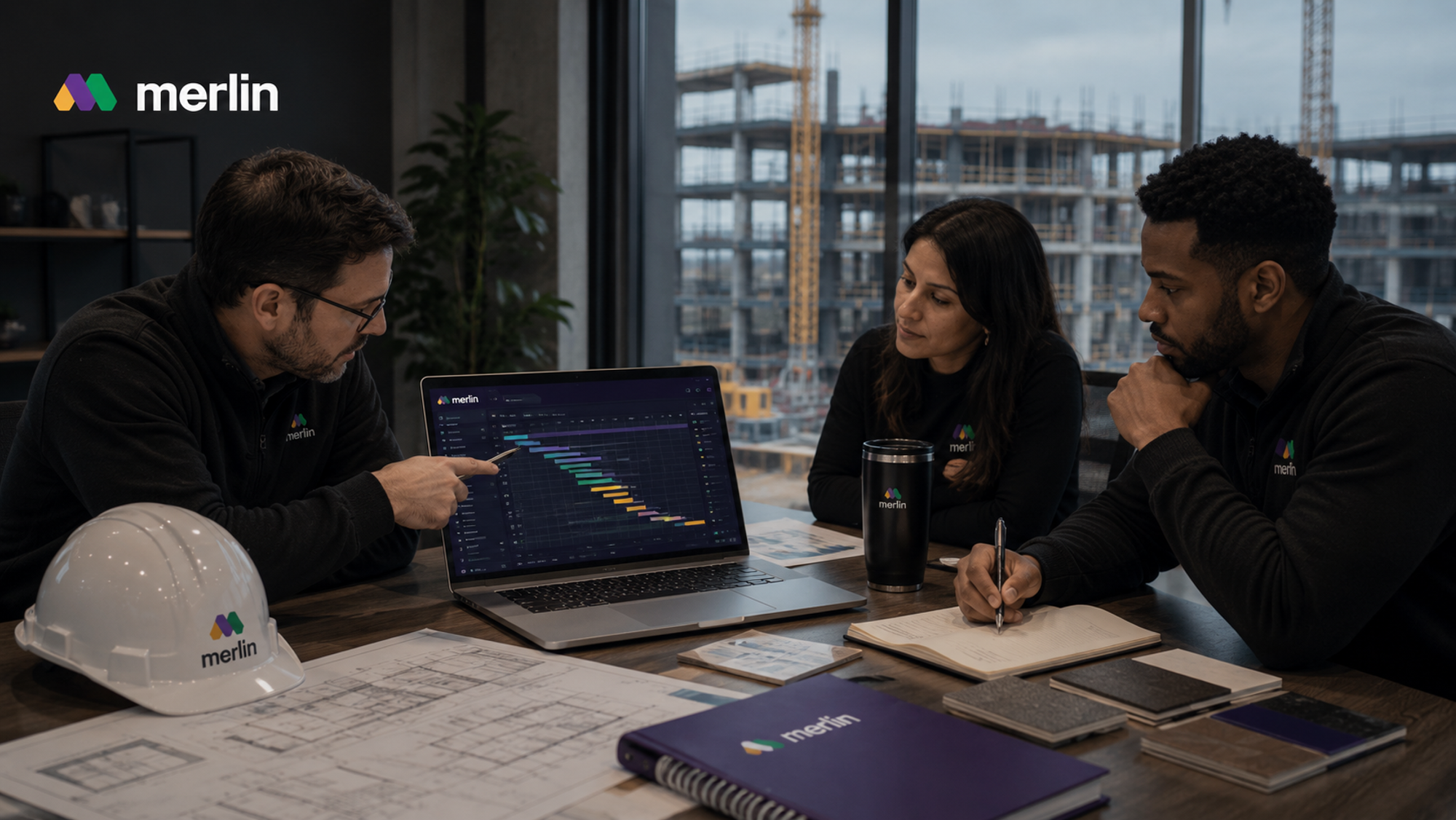
If your business builds the same product over and over the same unit type, the same modular layout, the same prototype building across multiple sites you already have a repeatable building. What most contractors running repeatable building programs don't have is a repeatable schedule. And that gap is quietly costing them the entire advantage repeatability was supposed to create.
This guide breaks down why traditional scheduling approaches fail repeatable building programs, what AI-powered construction scheduling actually changes, and how it fits into the broader shift toward AI across architecture, engineering, and construction (AEC). By the end, you'll have a clear framework for evaluating construction scheduling software and understanding where it connects to the rest of your operation from supply chain coordination to full project management.
The Repeatability Paradox
Here's the paradox at the center of production-style construction: the building is repeatable, but every schedule for it gets built from scratch.
A contractor running a multifamily modular program, a prototype retail rollout, or a standardized healthcare build-out will often re-estimate, re sequence, and re-schedule each new site as if it were a brand-new project even though 80–90% of the scope, sequence, and duration logic is identical to the last ten sites they built. The schedule becomes the bottleneck in an otherwise standardized process.
Why does this happen? Because most scheduling tools are built around the project as the unit of work, not the building type. They have no memory of how long framing actually took on the last twelve identical units, no record of which trade sequencing caused delays last time, and no way to apply those lessons automatically to the next schedule. Every project manager is left rebuilding institutional knowledge that should already exist in the system.
This is precisely the problem AI-powered construction scheduling software is built to solve not by making scheduling smarter in the abstract, but by making it learn from repetition the way the building process itself already does.
What Changes With AI-Powered Construction Scheduling Software
At its core, AI-powered construction scheduling software applies machine learning and historical project data to the scheduling process in three specific ways:
1. Pattern-based sequencing. Instead of a scheduler manually sequencing every trade and task from a blank template, the system recognizes that "this is a repeatable unit type" and proposes a sequence based on how similar builds actually performed, not how they were planned to perform on paper.
2. Predictive duration estimates. Traditional schedules use static duration assumptions per task. AI-powered systems adjust those durations based on real historical performance across your own completed projects accounting for crew size, site conditions, and even seasonal factors that repeatedly affected past builds.
3. Dynamic risk and delay forecasting. Rather than waiting for a delay to show up on a Gantt chart after it's already happened, AI-powered construction project management software for scheduling can flag emerging risk a trade running behind on a comparable unit, a material lead time trending longer than historical average early enough to actually act on it.
The result isn't just a faster way to build a schedule. It's a schedule that gets more accurate every time you build the same thing again which is exactly the compounding advantage that repeatable construction programs are supposed to deliver but rarely do with legacy tools.
AI in Architecture, Engineering, and Construction
Scheduling doesn't exist in isolation; it's one part of a much broader shift happening across AEC. Understanding where scheduling fits in that bigger picture helps clarify what to expect (and not expect) from any single tool.
Across the industry, AI is being applied at several distinct stages:
- Design and pre-construction — AI-assisted generative design, clash detection, and early cost modeling, helping architects and engineers explore more design options faster.
- Planning and scheduling — the layer this guide focuses on: sequencing, duration prediction, and resource-aware timelines.
- Execution and field operations — computer vision for progress tracking, AI-assisted quality inspection, and automated reporting from the job site.
- Supply chain and procurement — predictive material lead times and demand forecasting, which directly feed back into how reliable a schedule can be in the first place. A schedule is only as good as its assumptions about material availability, which is why scheduling and Supply Chain Coordination are increasingly treated as a single connected discipline rather than separate systems.
The contractors getting the most value from AI in AEC aren't the ones adopting the flashiest point solution in any one category, they're the ones connecting these layers so that data flows between them. A scheduling tool that doesn't know about material lead times, or a design tool that doesn't inform pre-construction sequencing, only delivers a fraction of the available value.
AI-Powered Build and Construction Tools: What's Actually on the Market
"AI-powered construction tools" has become a crowded label, and not every tool wearing it delivers the same thing. Broadly, the tools available today fall into a few categories:
Scheduling and sequencing tools — the focus of this guide, purpose-built to generate, adjust, and optimize construction timelines using historical and real-time project data.
Progress monitoring tools — using site cameras, drones, or mobile capture combined with computer vision to compare actual progress against the schedule automatically, rather than relying on manual field reports.
Design and BIM-adjacent tools — AI layered into building information modeling workflows to catch clashes, optimize layouts, or generate design variations faster than manual iteration allows.
Cost and estimating tools — AI-assisted estimating that draws on historical cost data to generate more accurate bids, particularly valuable for repeatable building programs where cost patterns repeat as reliably as construction sequences do.
For repeatable building programs specifically, scheduling tools deliver the most immediate return, because sequencing and duration logic repeat almost exactly from build to build which is exactly the kind of pattern machine learning is best at recognizing and improving on.
AI Tools for Construction Project Management
It's worth being precise about where scheduling fits relative to project management as a whole, because the two get conflated often.
Construction project management covers the full scope of running a job: budgets, submittals, RFIs, stakeholder communication, documentation, and yes scheduling. AI tools for construction project management typically apply machine learning across several of these functions simultaneously: flagging submittal delays before they cascade, summarizing RFI backlogs, predicting budget overruns based on current burn rate, and generating or adjusting schedules.
The strongest AI-powered construction project management software for scheduling treats the schedule not as a static document to be checked periodically, but as a living model that updates as real project data comes in labor hours logged, materials delivered, inspections passed and recalculates downstream impacts automatically. That's a meaningfully different experience from a project manager manually updating a Gantt chart once a week based on a status meeting.
For a full breakdown of how project management platforms compare feature-for-feature and where scheduling-specific AI tools should sit alongside a broader PM system rather than replace it see our dedicated page on Construction Project Management Software.
What Are the Best AI Tools for Building Design and Architecture?
While this guide is focused on scheduling, repeatable building programs almost always start upstream at design. It's worth understanding what AI is doing at the design and architecture stage, since design decisions directly shape how repeatable (and how schedulable) a building program actually is.
The strongest AI tools for building design and architecture today generally fall into these categories:
- Generative design tools that explore multiple layout or massing options against a set of constraints (site conditions, unit mix, code requirements) far faster than manual iteration.
- Clash detection and coordination tools layered into BIM workflows, catching conflicts between structural, mechanical, and architectural systems before they become field problems.
- Parametric and modular design platforms, particularly relevant for repeatable building programs , let architects adjust a standardized design template across variables (site dimensions, unit count, local code) while preserving the repeatable core that makes the building efficient to construct.
- Early-stage cost and feasibility tools that estimate cost and schedule impact of design decisions before they're locked in, closing the loop between design intent and construction reality.
The connective tissue between design-stage AI and scheduling-stage AI is data: a parametric design tool that outputs consistent, structured data about a repeatable unit type gives scheduling software a much stronger foundation to build predictive sequences from. Contractors who treat design and scheduling AI as separate, disconnected investments tend to see far smaller gains than those who think about the two as feeding each other.
Making the Business Case: Why This Matters for Repeatable Building Programs Specifically
It's worth being direct about who benefits most from AI-powered construction scheduling software, because the value proposition is meaningfully stronger for repeatable programs than for fully custom, one-off construction.
For a custom home builder or a bespoke commercial project, every schedule genuinely is closer to a blank slate there's less historical pattern to learn from, so AI-driven prediction has less to work with. For contractors running repeatable building programs modular housing, prototype retail, standardized healthcare or hospitality builds, production style residential the opposite is true. Every completed unit adds to a dataset the system can learn from, and the value compounds. Site 20 gets a materially more accurate, more reliable schedule than site 1 did, purely because the system has learned from the nineteen builds in between.
That compounding advantage is the entire point of running a repeatable building program in the first place. Without AI-powered scheduling, that advantage stays locked in the heads of your most experienced project managers. With it, the advantage becomes systematized transferable to every new project manager, every new site, every new market you expand into.
And because schedule reliability depends directly on material and labor availability, the full value of AI-powered scheduling is only realized when it's connected to real-time Supply Chain Coordination data a schedule that assumes materials will arrive on time isn't actually predictive if it can't see procurement risk coming.
Frequently Asked Questions
1. What is AI-powered construction scheduling software?
AI-powered construction scheduling software uses machine learning and historical project data to generate, adjust, and optimize construction timelines predicting task durations, sequencing trades, and flagging delay risk based on how similar past projects actually performed, rather than relying solely on static, manually built schedules.
2. How is AI-powered scheduling different from traditional construction scheduling software?
Traditional scheduling software requires a scheduler to manually build sequences and estimate durations for each new project, largely from scratch. AI-powered scheduling software learns from historical project data, so sequencing and duration estimates improve automatically as more projects are completed a distinction that matters most for contractors running repeatable building programs.
3. Which contractors benefit most from AI-powered construction scheduling? Contractors running repeatable building programs modular housing, prototype retail rollouts, standardized healthcare or hospitality construction see the largest benefit, because AI scheduling tools improve with every repeated build. Fully custom, one-off projects have less historical pattern for the system to learn from, so the gains are smaller (though still meaningful for risk forecasting).
4. Does AI-powered scheduling replace the need for a project manager or scheduler?
No. AI-powered scheduling tools are designed to remove the manual, repetitive work of rebuilding sequences and duration estimates from scratch, and to surface risk earlier not to replace the judgment of a project manager. The technology handles pattern recognition and prediction; people still make the decisions about trade-offs, priorities, and client communication.
5. How does AI-powered scheduling connect to supply chain and procurement? A construction schedule is only as reliable as its assumptions about material and equipment availability. AI-powered scheduling tools deliver their full value when connected to real-time supply chain data material lead times, delivery status, procurement risk so the schedule can adjust proactively rather than reacting after a delay has already occurred.