Batch Production for Contractors: Why Repeatable Work Beats One-Off Builds
Contractors can improve shop efficiency by turning repeatable components into batch-produced assemblies instead of treating every build as custom.
 Sneha Kumari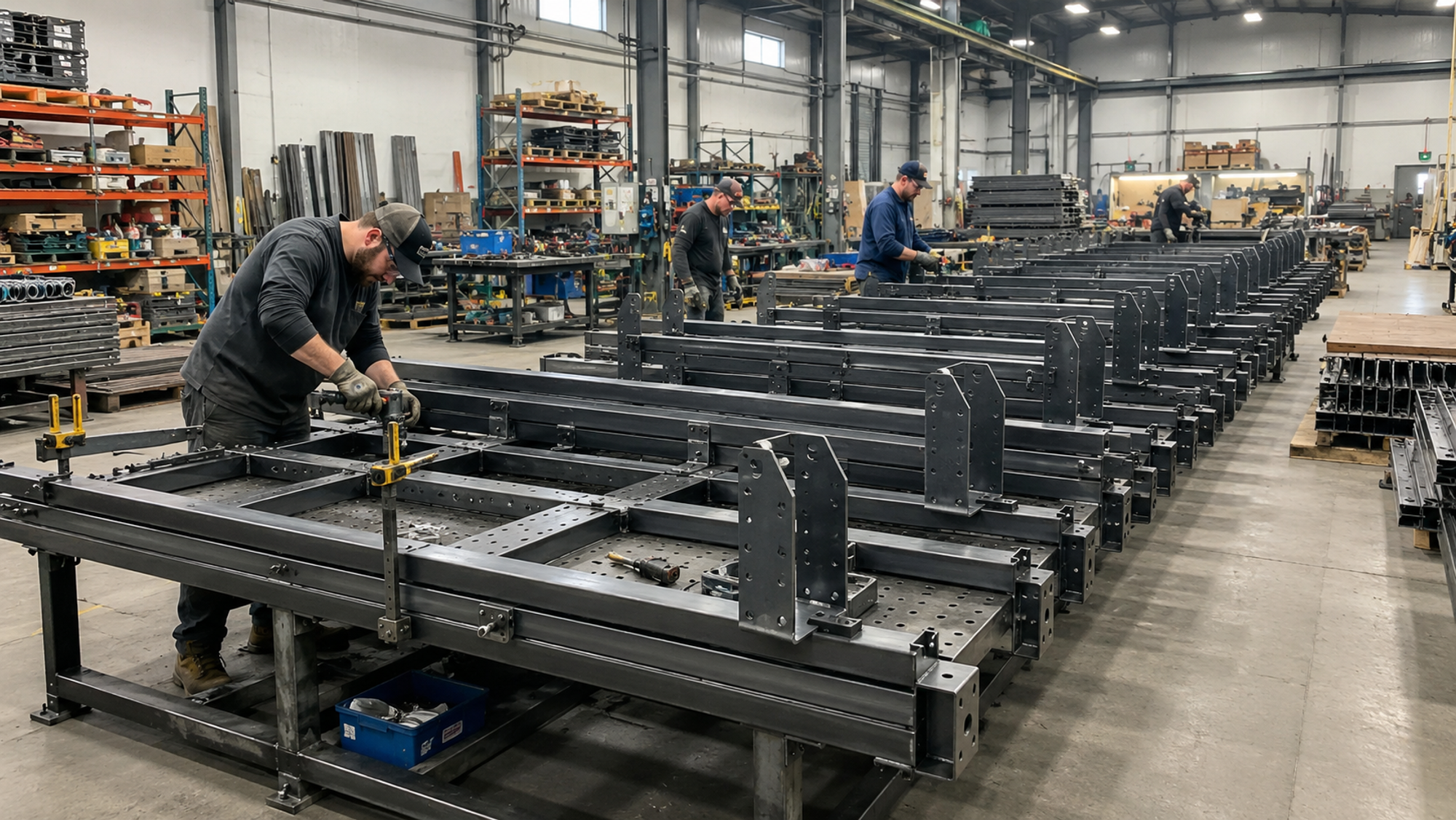
Every contractor who opens a shop eventually runs into the same fork in the road: keep building everything custom, the way it's always been built in the field, or start standardizing pieces of the work into repeatable assemblies that can be run in batches. The instinct for a lot of contractors is to default to custom that's how the trade has always operated, and every job feels a little different from the last one. But the contractors getting the most out of their shop investment are the ones who've found the parts of their work that don't actually need to be different every time, and turned those into repeatable, batch-produced runs.
This isn't an argument for turning every contractor into a manufacturer who only builds one thing. It's about recognizing that most jobs are a mix of genuinely unique requirements and components that repeat constantly across projects and building a production approach that treats those two categories differently.
What "Custom Every Time" Actually Costs
Building everything as a one-off has a hidden cost that doesn't show up cleanly in a single job's budget, but shows up clearly across a year of jobs: every assembly has to be planned, measured, and built from scratch, every time, even when 80% of it is identical to something the shop built last month.
That repetition without standardization means more time spent on layout and setup relative to actual production time, more opportunities for measurement or fabrication errors because nothing is templated, and far less predictability in how long a given run will actually take. A shop running entirely custom work has a much harder time forecasting its own capacity, because every job is, by definition, a new variable.
What Batch Production Actually Means for a Contractor
Batch production doesn't mean every job looks the same to the customer. It means identifying the components within a job that repeat a particular duct configuration, a standard rack assembly, a recurring connection detail and building those as standardized, templated runs rather than one-off fabrications.
The job as a whole can still be fully custom in its overall design. What changes is how the shop approaches the repeating pieces inside that design. Once a component is standardized, it can be produced in batches ahead of need, run by less senior staff because the steps are templated, and quality-checked against a known standard rather than evaluated case by case.
How to Find What's Actually Repeatable
The contractors who do this well don't try to standardize everything at once. They start by looking back at a stretch of recent jobs and asking a simple question: which components or assemblies showed up, in close to the same form, across multiple projects?
In mechanical and specialty contracting, this is very often hangers, supports, common duct or pipe configurations, standard rack or skid assemblies, and connection details that follow code-driven patterns rather than project-specific design choices. These are exactly the components that benefit most from being pulled out of the "custom" bucket and into a batch-production process they're produced constantly, they follow predictable specs, and standardizing them frees up the shop's most skilled fabricators to spend their time on the parts of the job that genuinely require custom judgment.
The Efficiency Gap This Closes
Once a contractor has identified a repeatable component, batch production closes the efficiency gap in a few concrete ways.
Setup time gets amortized across many units instead of one. A jig, template, or cut pattern built once gets reused dozens or hundreds of times, instead of every unit absorbing its own full setup cost.
Quality becomes consistent rather than variable. When the same component is built the same way every time, defects get caught against a known standard, and the shop isn't relearning the same lessons on every job.
Capacity becomes forecastable. A shop that knows it can run a given batch of standardized components in a known amount of time can plan its schedule with real confidence — which connects directly to scheduling shop production around confirmed jobsite need-dates, since a predictable batch-run time is what makes that kind of scheduling model possible in the first place.
Where This Intersects With the Decision to Open a Shop at All
For contractors who are still early in deciding whether shop production makes sense for their business, the case for batch production is closely tied to the broader case for opening a warehouse in the first place. A warehouse without batch-producible, repeatable work inside it is mostly just covered storage. A warehouse that's organized around standardized, repeating components becomes a genuine production asset because the repeatability is what justifies dedicating space, staff, and equipment to producing ahead of need rather than reacting to it.
Batch Production and the Self-Perform Decision
There's also a connection here to how contractors think about bringing self-perform work in-house. Self-performing more of the work only pays off if the contractor can do it more efficiently than a subcontractor would and batch production of repeatable components is one of the clearest ways to actually achieve that efficiency gap. Without standardization, self-performed work tends to inherit all the same inefficiencies as subcontracted work, just under a different name on the org chart. With it, self-performed work can genuinely outproduce what a sub would deliver, on cost and on schedule.
Starting Small and Proving the Model
Contractors who try to standardize everything at once tend to stall out, because the up-front work of templating, jigging, and documenting a process for every component is significant. The contractors who succeed tend to start with one or two of the highest-volume, most repeatable components, prove out the batch process on those, and only then expand the list. This also gives the shop floor team a chance to build confidence in the new way of working before being asked to run an entirely standardized operation.
The goal isn't to eliminate custom work. It's to stop treating repeatable work as if it were custom, and free up the shop's capacity and attention for the parts of the job that actually deserve a one-off approach.
Merlin EOS gives contractors a way to flag and track which assemblies are standardized versus custom, so batch-run components get scheduled, produced, and tracked differently from genuinely unique work — without forcing every job into a rigid, one-size-fits-all production model.
"A shop that knows it can run a given batch of standardized components in a known amount of time can plan its schedule with real confidence which connects directly to scheduling shop production around confirmed jobsite need-dates."
"the case for batch production is closely tied to the broader case for opening a warehouse in the first place."
About Merlin AI
Merlin is the operational intelligence and execution orchestration platform built for the construction industry continuously aligning materials, labour, cost, and decisions in real time across every active project. The platform serves three participants in the construction ecosystem: contractors industrialising through prefab, self-perform, and warehouse operations; developers who need their supply chain to coordinate like a production system; and suppliers looking for a direct route into live construction projects. Merlin EOS runs production operations, Merlin PI coordinates projects, and Merlin Merchant connects suppliers to work. Unlike tools that report on work after the fact, Merlin orchestrates it while it is happening. When Merlin runs production, execution becomes inevitable.
Frequently Asked Questions
1. Does batch production mean a contractor stops doing custom work? No. Most contractors run a mix fully custom design at the project level, with standardized, batch-produced components inside that design wherever the same assembly repeats across jobs. The two approaches coexist within the same project.
2. How do I know which components are worth standardizing first? Look at the last several months of completed jobs and identify which assemblies or components showed up repeatedly in close to the same form. Those are the strongest candidates, because the setup cost of standardizing them gets amortized fastest.
3. Does batch production require new equipment? Not necessarily. In many cases it starts with templates, jigs, and documented processes for existing equipment, rather than new machinery. The bigger investment is usually in the upfront process design, not in capital equipment.
4. How does batch production affect lead times? Standardized components can often be produced ahead of confirmed need, because the shop already knows roughly how long a batch run takes and doesn't need to wait for full project-specific design before starting. This generally shortens effective lead times compared to fully custom fabrication.
5. Is batch production only useful for very large contractors? No. Even a small shop benefits from identifying its two or three most-repeated assemblies and standardizing those first. The scale of the operation changes how big the batches are, not whether the underlying approach makes sense.