Construction Opportunity Tracking Software: How Suppliers Find, Prioritize, and Win More Projects
Find projects earlier, prioritize the right opportunities, track RFQs, and build a stronger sales pipeline with construction opportunity tracking software.
 Sneha Kumari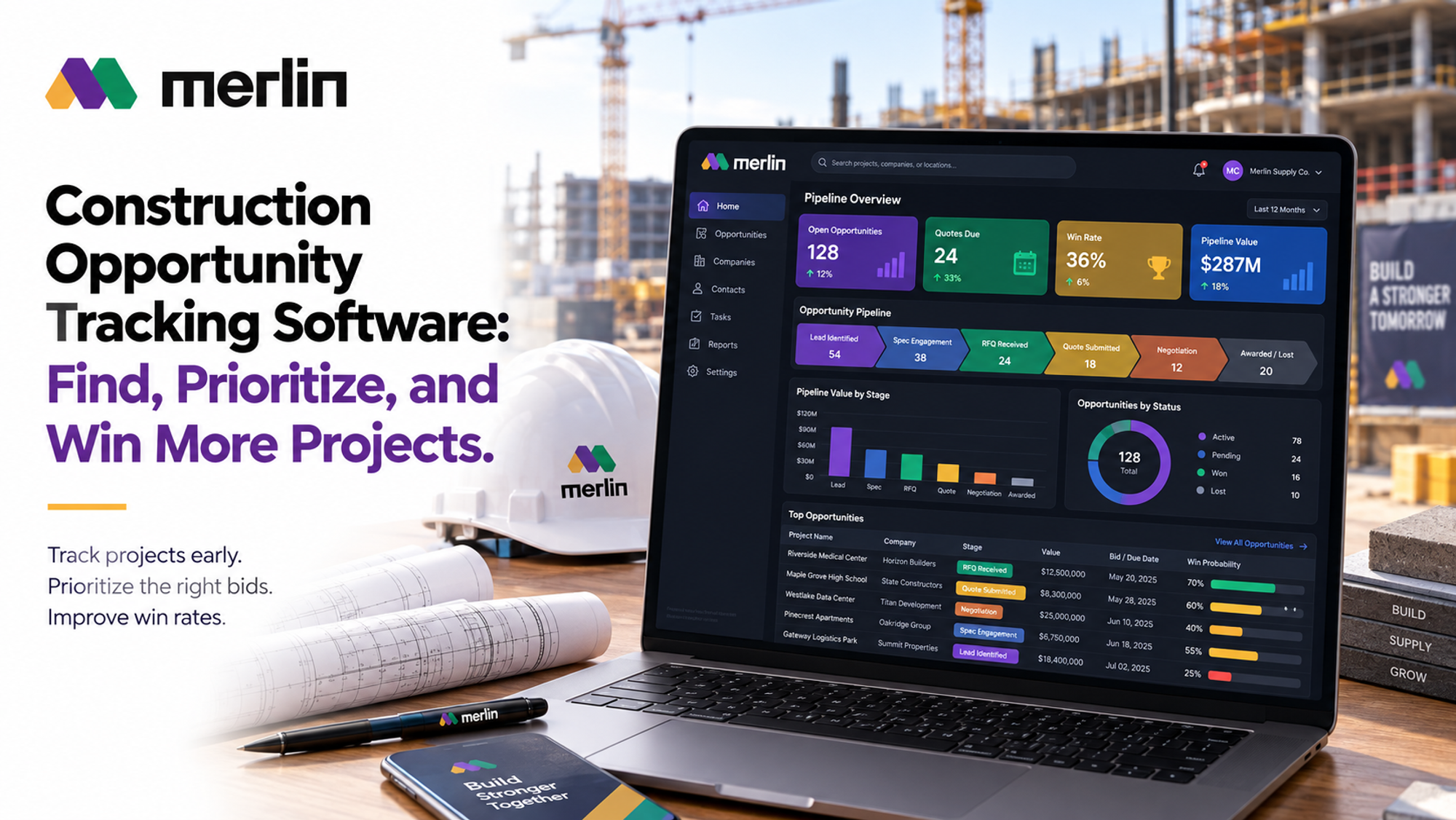
Every construction supplier has lost a job they should have won, not because the price was wrong, but because the opportunity was tracked in someone's inbox, or not tracked at all, until it was too late to compete properly. As projects move through design, specification, and procurement, suppliers who rely on spreadsheets and memory to manage their pipeline miss early signals, chase the wrong bids, and lose visibility into deals that go quiet for weeks at a time.
Construction Opportunity Tracking Software fixes this by giving fabricators, distributors, and manufacturers a structured system for finding projects early, scoring which ones are worth pursuing, and measuring what actually drives a higher bid win rate. This guide walks through what the software does, how it manages project based sales and bidding, which suppliers benefit most, the features worth prioritizing, and how tracking data turns into a stronger, more predictable sales pipeline.
What Is Construction Opportunity Tracking Software
Construction Opportunity Tracking Software is a system that helps building product suppliers capture, organize, and monitor every project they could potentially sell into, from the moment a lead surfaces to the moment a purchase order is signed or lost. Instead of relying on scattered emails, spreadsheets, and memory, the software gives a sales team one place to log a project, tag the stage it is in, and see what needs to happen next.
For a construction supplier, whether a fabricator, distributor, or manufacturer, projects rarely close in a single conversation. A job might sit in early design for months before it reaches the RFQ stage, and a supplier who is not tracking it during that window has no way to influence the specification or prepare a competitive quote when the request finally arrives. Opportunity Tracking Software for construction solves this by treating each project as a living record: who the buyer is, what stage the job is at, what materials are involved, and what the supplier's win probability looks like.
This is different from a generic sales CRM. Construction opportunities move through project based stages rather than a simple lead to customer funnel, and the same building can generate multiple separate opportunities across trades, phases, or bid packages. A construction specific system accounts for that structure instead of forcing a supplier's pipeline into a format built for retail or subscription sales. That distinction is also what separates a true purpose built construction ERP from a generic business suite adapted after the fact.
Understand How Construction Opportunity Tracking Software Manages Project Based Sales and Bidding
Construction Opportunity Tracking Software manages sales the way construction actually happens: as a series of stages tied to a physical project rather than a generic deal size. Each opportunity typically moves through stages such as lead identified, specification or design engagement, RFQ received, quote submitted, negotiation, and award or loss. The software holds all of this in one record, so a sales rep, an estimator, and a manager are always looking at the same information instead of three different versions of the truth.
This structure matters because construction bidding software for suppliers has to answer a different question than a typical CRM does. A generic CRM asks whether a contact is ready to buy. A construction sales pipeline software setup asks whether a project is ready to be quoted, and whether the supplier has the capacity and margin to make pursuing it worthwhile. Most platforms track:
- Project name, location, and general contractor or developer
- Bid or RFQ deadline, along with any addenda that update scope
- Estimated project value and the supplier's likely share of it
- Stage in the procurement cycle, from early tracking through award
- Notes on relationships, including the architect who specified the product, the buyer managing the RFQ, and the contractor's known preferences
Because bids are tied to real deadlines, most platforms also layer in reminders and automated follow up so a sales rep is not relying on memory to know that a quote validity period is closing or that a decision maker has gone quiet for two weeks. This is close to how construction sales pipelines linked to production capacity already function inside a broader ERP: the same record that shows a bid is due Friday also shows whether the shop floor can actually deliver if the bid is won.
How Construction Opportunity Tracking Software Helps Suppliers Find Projects Before Bidding Begins
Construction Opportunity Tracking Software helps suppliers find projects before bidding begins by surfacing early signals: permit filings, planned developments, and design or specification activity, so a sales team can engage before an RFQ is ever issued. By the time a formal bid request lands in an inbox, the project has often already been shaped by conversations that happened months earlier, and a supplier absent from that window starts the race several steps behind.
Most opportunity tracking platforms pull this early visibility from a mix of sources:
- Public project and permit data that flags new construction activity in a supplier's service area
- Plan room and bid board integrations that centralize RFQs from multiple general contractors in one place
- Manual entry from field reps or account managers who hear about upcoming work directly from architects, developers, or contractors
- Relationship history, so a project connected to a known buyer or specifier is flagged automatically instead of discovered by chance
Getting in early also changes the nature of the conversation. A supplier who is specified by the design team before procurement starts has already established a value position, while a supplier who only sees a project once an RFQ arrives is competing on price alone against a spreadsheet of comparable quotes. This idea is explored in more depth in construction supplier pricing strategy, which looks at why value arguments have to be made before the procurement decision rather than during it.
Which Construction Suppliers Benefit From Opportunity Tracking Software
Any construction supplier who sells into project based work, rather than pure retail or stocked distribution, benefits from Opportunity Tracking Software for construction. That includes:
- Fabricators and manufacturers of building products such as steel, precast, windows, doors, or millwork, who quote against drawings and specifications for specific jobs
- Distributors who supply materials to multiple contractors across many active projects at once and need to track which jobs are open, which are awarded, and which have gone quiet
- Modular and offsite manufacturers who need visibility into a project's timeline well before production scheduling begins
- Specialty trade suppliers, such as mechanical, electrical, or plumbing product suppliers, whose products get specified early and quoted repeatedly as a design evolves
The common thread is a sales process that runs across weeks or months per opportunity, with multiple stakeholders, competing bids, and a real cost to chasing the wrong jobs. A supplier who ships standardized products to walk in customers has less need for this kind of system. A supplier chasing forty open bids across a dozen general contractors, each with a different deadline and decision maker, cannot manage that reliably with a shared spreadsheet. This is the gap that Merlin Merchant is built to close, giving suppliers a direct route into live construction projects instead of relying on word of mouth and cold outreach alone.
What Key Features Should Construction Suppliers Look for in Opportunity Tracking Software
The most useful construction opportunity tracking platforms share a small set of core capabilities, and suppliers evaluating options should look for all of them rather than treating any single feature as sufficient on its own.
- Project and stage visibility: a clear view of every open opportunity, what stage it is in, and what action is due next
- RFQ software for construction suppliers built into the same system, so incoming quote requests land directly in the pipeline instead of a separate inbox
- Quote and pricing history tied to each project, so a rep can see what was quoted before, at what margin, and to whom
- Deadline and follow up reminders that account for bid dates, quote validity periods, and decision timelines
- Reporting on win rate, pipeline value, and stage conversion, broken down by rep, product line, or customer type
- Integration with estimating and production data, so a sales commitment reflects what the business can actually deliver on time, in line with faster and more accurate bid packages that come from automating takeoffs at the estimating stage
A system that only tracks contacts and deal size, without accounting for bid deadlines, specification stage, or production capacity, will eventually push a supplier back toward spreadsheets for the details that actually decide whether a job is won.
How Can Suppliers Prioritize the Right Construction Opportunities
Suppliers can prioritize the right construction opportunities by scoring each one against a consistent set of criteria rather than pursuing every RFQ that arrives. Not all construction work is equally worth winning, and a supplier who treats every bid as equally important ends up spending estimating capacity on low value jobs while higher value opportunities compete for the same limited attention.
A construction sales pipeline software setup typically supports prioritization through a few mechanisms:
- Fit scoring: how closely the project's product, volume, and timeline match what the supplier is best positioned to deliver
- Margin potential: whether the job supports the supplier's target margin, or whether it only makes sense as a strategic account building move
- Relationship strength: whether the supplier has an existing connection to the specifier, contractor, or developer that improves the odds of winning
- Capacity check: whether current production or delivery capacity can actually support the job if it is won, so sales commitments and shop floor reality stay aligned
- Deadline proximity: surfacing opportunities with approaching bid dates so nothing is missed simply because it was not the most recent addition to the pipeline
By scoring opportunities this way, a sales team can decide deliberately which jobs to chase, which to decline, and which need a different pricing or engagement strategy, instead of reacting to whatever RFQ happened to arrive most recently.
How Opportunity Tracking Helps Suppliers Improve Bid Win Rates
Opportunity tracking helps suppliers improve bid win rates by making the sales process measurable, so a team can see exactly where deals are being lost and fix that specific problem instead of guessing. Without stage level data, a supplier only knows the final outcome, won or lost, with no visibility into whether the issue was late follow up, uncompetitive pricing, or a missed deadline.
With a structured pipeline, suppliers typically track:
- Win rate by stage, showing where opportunities most often stall or get dropped
- Win rate by rep, product line, or project type, which highlights coaching opportunities and where a supplier's real strengths lie
- Average time from RFQ to submitted quote, since slow response times lose jobs even when pricing is competitive
- Follow up consistency, since many bids are lost simply because no one reached back out before a decision was made
This data also improves how a supplier bids going forward. Historical quote and outcome data shows which project types, customers, and price points actually convert, so future bidding decisions rest on evidence rather than instinct. Over time, that turns win rate from a number a supplier finds out about after the fact into a metric the sales team can actively manage, one opportunity at a time.
Frequently Asked Questions
What is the difference between construction opportunity tracking software and a general CRM?
General CRMs are built around a simple lead to customer funnel. Construction opportunity tracking software is built around project based stages, such as specification, RFQ, quote, negotiation, and award, tied to a physical project with its own deadlines, drawings, and multiple stakeholders.
Do small construction suppliers need opportunity tracking software, or is it only for large distributors?
Any supplier managing more than a handful of open bids at once benefits, regardless of size. A small fabricator chasing ten active RFQs faces the same visibility problem as a larger distributor chasing a hundred, just at a smaller scale, and a spreadsheet tends to break down at roughly the same point for both.
How is RFQ software for construction suppliers different from opportunity tracking software?
RFQ software specifically manages incoming quote requests: receiving them, responding, and tracking submission deadlines. Opportunity tracking software is broader and includes RFQ management as one stage within a full project pipeline that starts before an RFQ is issued and continues through award or loss.
Can opportunity tracking software integrate with estimating and production scheduling?
Yes, and this integration is one of the more valuable features for suppliers. When sales, estimating, and production share the same data, a sales rep can commit to a delivery timeline that reflects real shop floor or supply chain capacity rather than an assumption.
What metrics should a construction supplier track to measure sales pipeline performance?
Common metrics include win rate by stage and by rep, average time from RFQ to submitted quote, pipeline value by stage, and follow up consistency. Together, these show where opportunities are lost and where a supplier's sales process is already working well.
Construction Opportunity Tracking Software is not a nice to have for suppliers chasing project based work. It is what turns a pipeline of scattered leads and inboxes full of RFQs into a system a sales team can actually manage, prioritize, and improve over time. For construction suppliers who want opportunity tracking connected to pricing, estimating, and production rather than running as a standalone tool, the MerlinAI construction ERP platform brings Merlin Merchant's supplier tools together with the rest of the build process.