How Modern Construction Teams Manage RFQs, Supplier Bids, and Procurement in One Platform
Manage RFQs, supplier bids, and purchase orders in one construction procurement platform for faster purchasing and better cost control.
 Sneha Kumari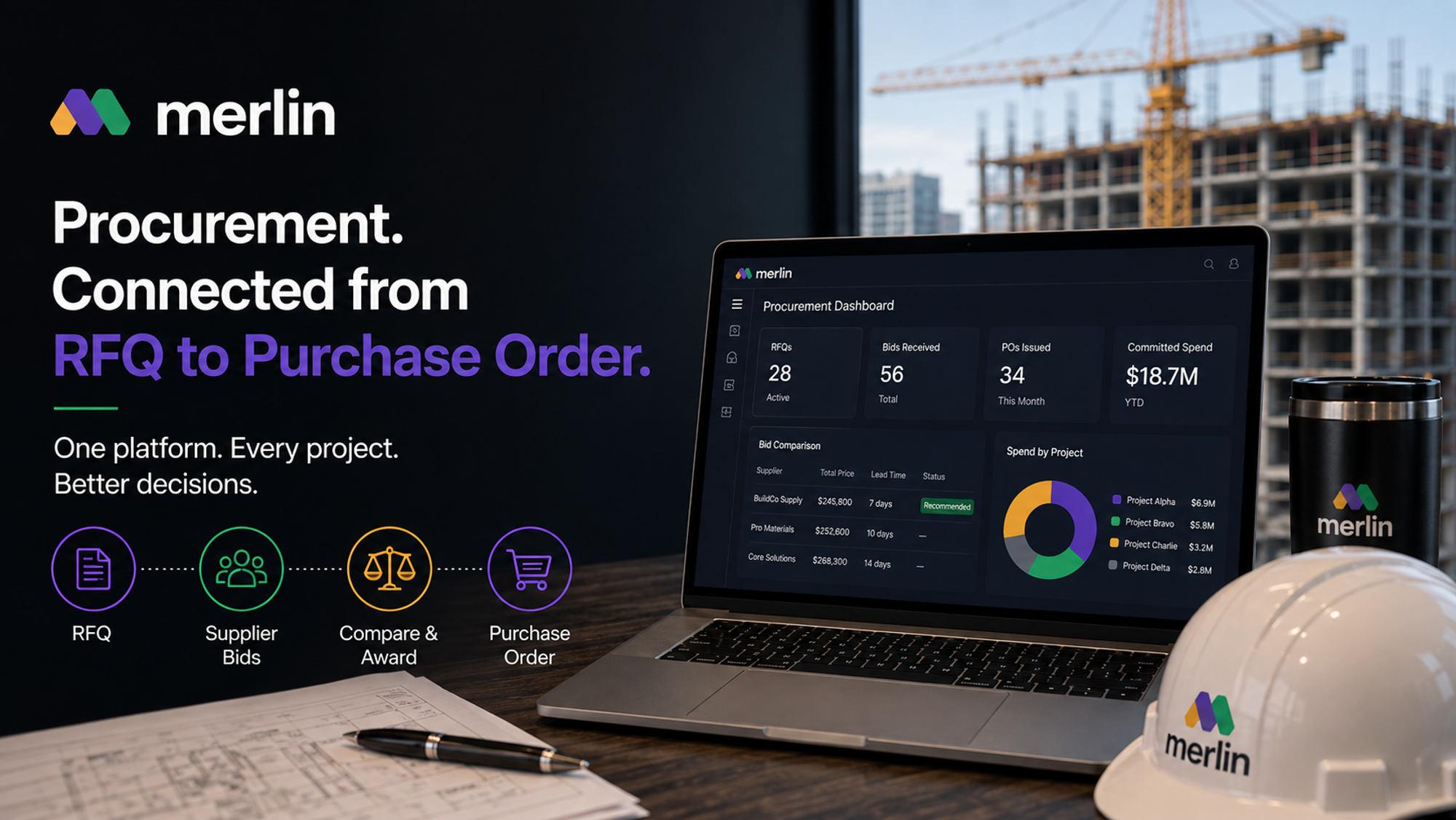
Construction procurement rarely fails because a project team picked the wrong supplier. It fails because the RFQ, the supplier bids, and the resulting purchase order were never connected in the first place, spread instead across email threads, spreadsheets, and whichever project manager happened to run point on a given trade package. That fragmentation is manageable on one project. It becomes a real cost and schedule risk the moment a contractor is running several projects at once, each with its own stack of RFQs, quotes, and purchase orders that nobody outside that project can see.
This is the gap that a modern construction procurement platform is built to close. Rather than treating RFQ management, supplier bid management, and purchase workflow as three separate tasks handled by three separate tools, a connected system carries a request for quote through supplier response, bid comparison, award, and purchase order as one continuous record. Below is a closer look at why procurement gets harder as projects scale, what it actually looks like to manage RFQs, bids, and purchasing from one system, and the features worth checking for before choosing a construction procurement platform for your own team.
Why Construction Procurement Gets More Complex as Projects Scale
On a single project, procurement can survive on spreadsheets, email threads, and phone calls. A project manager sends a request for quote to three or four suppliers, waits for prices to come back, picks one, and issues a purchase order. It is slow, but it works because the volume is low enough that one person can hold the whole process in their head.
That approach breaks down the moment a contractor is running several projects at once. Multiply the number of RFQs by five active jobs and a dozen trade packages per job, and the same manual process turns into a full time coordination problem. Quotes arrive in different formats. Some suppliers respond in days, others in weeks. Purchase orders get issued from memory rather than from a documented comparison, and nobody can say with confidence which supplier was actually the best choice on a given package. When construction projects fall behind schedule, a fragmented procurement process is very often part of the reason, because materials that were never properly tracked from RFQ to delivery show up late or short.
The complexity does not only come from having more projects. It comes from having more people involved in the buying decision. Estimators, project managers, warehouse staff, and field supervisors all touch procurement at different points, and if each of them is working from a different spreadsheet or a different inbox, the organization loses a single source of truth for what was quoted, what was awarded, and what was actually purchased. This is especially true for general contractors that are taking more scopes of work in house, since self performing crews still need materials sourced, quoted, and purchased, just without a subcontractor absorbing that coordination burden on the contractor's behalf.
Construction procurement software exists to solve exactly this problem. Rather than adding more spreadsheets or more email chains, a proper system gives every RFQ, every supplier bid, and every purchase order a single home that scales cleanly whether a contractor is running two projects or twenty.
Managing RFQs, Supplier Bids, and Purchase Workflows from One System
The core idea behind a modern construction procurement platform is simple: RFQs, supplier bids, and the purchase workflow that follows should all live in one connected system rather than three disconnected ones. Good construction RFQ management starts here, with a single, structured request rather than a document that gets rebuilt from scratch for every trade package. When a project manager needs materials or a specialty scope quoted, they build the RFQ once, attach the relevant specifications and drawings, and send it to a defined list of suppliers directly from the platform. There is no copying details into separate emails or retyping the same scope for every recipient.
From there, RFQ software for construction should track every response automatically. Instead of bid amounts sitting scattered across email attachments, each supplier's quote lands in a structured comparison view: price, lead time, quantities, and any exceptions the supplier has noted. That structure is what makes supplier bid management genuinely useful rather than just a digital filing cabinet. A project manager can see, at a glance, which supplier is fastest, which is cheapest, and which has flagged a substitution that needs review, without opening a single PDF.
Once a bid is awarded, the same system should carry that decision straight into a purchase order, with the negotiated pricing, quantities, and delivery dates already populated from the winning quote. This is the construction purchase workflow piece that most spreadsheet based processes get wrong: the RFQ and the purchase order are treated as two separate documents prepared by two different people at two different times, which is exactly where transcription errors and forgotten line items creep in. A connected platform, such as the construction operational intelligence platform MerlinAI provides, keeps the RFQ, the award decision, and the resulting purchase order as one continuous record instead of three disconnected files.
Procurement workflow software built this way also gives leadership a live view of committed cost. Because every purchase order traces back to an RFQ and a supplier bid, finance teams can see exactly what has been committed against a budget in real time, rather than waiting for invoices to surface spending after the fact.
How to Centralize Supplier Management, RFQs, and Procurement Across Multiple Projects
Centralizing procurement starts with centralizing the supplier list. Most contractors have supplier information scattered across old emails, individual project managers' contacts, and whatever the last person who negotiated a rate happened to write down. Construction supplier management means building one shared database of suppliers, their trades, their pricing history, their typical lead times, and how reliably they have delivered on past projects, so that every project team is drawing from the same pool of vetted vendors instead of rebuilding relationships from scratch on every job.
With that shared supplier base in place, RFQs can be issued consistently across projects rather than reinvented each time. A procurement workflow that has already been standardized on one project, for example a prefab metals package sourced for a mechanical contractor's shop, becomes a template that can be reused the next time a similar scope needs to be quoted. This kind of standardization is exactly what supports contractors delivering similar projects repeatedly, since a repeatable build depends on a repeatable, comparable procurement process behind it, not a fresh set of RFQs written from a blank page every time.
Centralized procurement also makes it possible to see supplier performance across the whole portfolio rather than just one project. A supplier who consistently quotes low but delivers late on one job will show the same pattern on the next job, and a centralized system surfaces that pattern instead of hiding it inside one project manager's memory. That portfolio level visibility is part of why some developers are pulling procurement decisions in house rather than leaving every trade partner to run its own separate purchasing process, and the same logic applies to contractors managing several active projects at once: the more scopes that run through one procurement platform, the clearer the picture of which suppliers actually perform.
Centralization does not mean every project has to buy from the same suppliers or follow identical specifications. It means every project team, regardless of which job they are staffed on, works inside the same system with the same standards for how an RFQ is written, how a bid is compared, and how an award decision gets documented.
Simplifying Supplier Bid Comparison, Evaluation, and Award Decisions
Comparing supplier bids side by side sounds simple until the quotes actually start arriving. One supplier quotes a lump sum, another breaks pricing out by line item, a third includes freight and a fourth does not, and suddenly a project manager is rebuilding every quote into a common spreadsheet format just to compare them fairly. That manual normalization step is where evaluation slows down and where award decisions get delayed past the point where they should have already been made.
A structured RFQ removes most of that friction before it starts, because suppliers are responding to the same defined scope, quantities, and required fields rather than free form pricing. When every bid comes back in the same shape, evaluation becomes a matter of scanning a comparison table rather than reconciling four different document formats. This is also where the buyer side of the process connects directly to the supplier side: platforms that make it easier for suppliers to respond quickly to construction RFQs are, from the buyer's perspective, the same platforms that produce faster, more complete, more comparable bids to evaluate.
Award decisions should also be documented, not just made. A clear system keeps a record of why a particular bid was selected, whether that reason was price, lead time, prior performance, or a scope clarification a supplier provided during the RFQ process. That audit trail matters for two reasons. First, it protects the contractor if a client or owner ever questions how a supplier was chosen. Second, it means the next project manager who runs a similar RFQ can see how past decisions were made instead of starting the evaluation logic from zero.
None of this requires slowing the process down. Structured bid comparison, when it is built into the RFQ and purchase workflow rather than bolted on afterward, actually shortens the time between sending an RFQ and issuing a purchase order, because the evaluation work happens continuously as bids arrive rather than in one rushed session after every supplier has responded.
Essential Features Every Construction Procurement Platform Should Offer
Not every piece of software that touches purchasing counts as a genuine construction procurement platform. Before committing to a system, it is worth checking that it covers the full cycle from RFQ to purchase order, not just one piece of it.
- RFQ creation and distribution: The ability to build a structured RFQ once, attach drawings and specifications, and send it to a defined supplier list directly from the platform, rather than exporting to email.
- Standardized bid comparison: A side by side view of supplier quotes that normalizes pricing, lead time, and quantities so evaluation does not depend on manually rebuilding every quote into a spreadsheet.
- Centralized supplier records: One shared database of suppliers, trades, pricing history, and past performance that every project team can draw on, rather than contacts scattered across individual inboxes.
- Purchase order automation: Awarded bids that convert directly into purchase orders with pricing and quantities already populated, closing the gap between the RFQ decision and the resulting order.
- Budget and commitment tracking: A live view of what has been committed against each project's budget as purchase orders are issued, rather than discovering overspend once invoices arrive.
- Field and warehouse visibility: Procurement data that connects to what is actually happening on site or in the shop, so ordering decisions reflect real material needs instead of guesswork.
- An audit trail: A documented history of every RFQ, every bid received, and every award decision, so procurement choices can be reviewed and repeated rather than reconstructed from memory.
A platform that covers each of these areas removes the need to stitch together a separate RFQ tool, a separate spreadsheet for bid comparison, and a separate accounting system for purchase orders. That stitching is exactly what fragments construction procurement in the first place, and it is worth noting alongside inventory management practices that move contractors from jobsite ordering to warehouse control, since procurement and inventory are really two halves of the same materials picture.
Building a Smarter Construction Procurement Process
Construction procurement gets harder as a company grows, not easier, simply because there are more projects, more suppliers, and more people touching the buying decision at once. Spreadsheets and email can carry a contractor through a handful of small jobs, but they were never built to hold RFQs, supplier bids, and purchase workflows together at the scale that a growing contractor eventually reaches.
A unified construction procurement platform brings RFQ management, supplier bid management, and purchase order execution into one connected system, so every decision is documented, every supplier is evaluated on the same terms, and every project manager is working from the same shared picture of committed cost. The goal is not to add another piece of software to an already crowded stack, but to replace several disconnected tools with one system that actually reflects how procurement happens on a real project, from the first RFQ to the last delivery.
Frequently Asked Questions
What is construction procurement software and how does it work?
Construction procurement software brings RFQ creation, supplier bid comparison, and purchase order management into a single connected system. Instead of tracking quotes across email and spreadsheets, project teams build RFQs, collect and compare supplier bids, and convert awarded bids directly into purchase orders, all within one platform.
How does RFQ management differ from supplier bid management?
RFQ management covers building and sending the request itself, including scope, quantities, and specifications. Supplier bid management picks up from there, covering how responses are collected, compared, and evaluated. A connected platform handles both stages as one workflow rather than two separate processes.
Can a construction procurement platform handle multiple projects at once?
Yes, and this is where centralized platforms show the most value. A shared supplier database and standardized RFQ process let project teams reuse proven workflows across jobs, while giving leadership visibility into supplier performance and committed spend across the entire portfolio, not just one project.
What features should I look for in RFQ software for construction?
Look for structured RFQ creation, standardized bid comparison, centralized supplier records, automated purchase order generation, budget tracking, and a documented audit trail. A platform missing any of these still leaves a gap that a spreadsheet or a separate tool will need to fill.
How does centralizing procurement improve purchase workflow for construction teams?
Centralizing procurement removes the manual handoffs between requesting quotes, comparing bids, and issuing purchase orders. When all three live in one system, award decisions convert directly into purchase orders, budgets update in real time, and every project team works from the same supplier data instead of rebuilding it project by project.