Construction Project Management: How Owner Teams Can Keep Consultants Aligned Throughout Every Project
Keep consultants aligned with construction project management software that improves coordination, document control, and project visibility.
 Sneha Kumari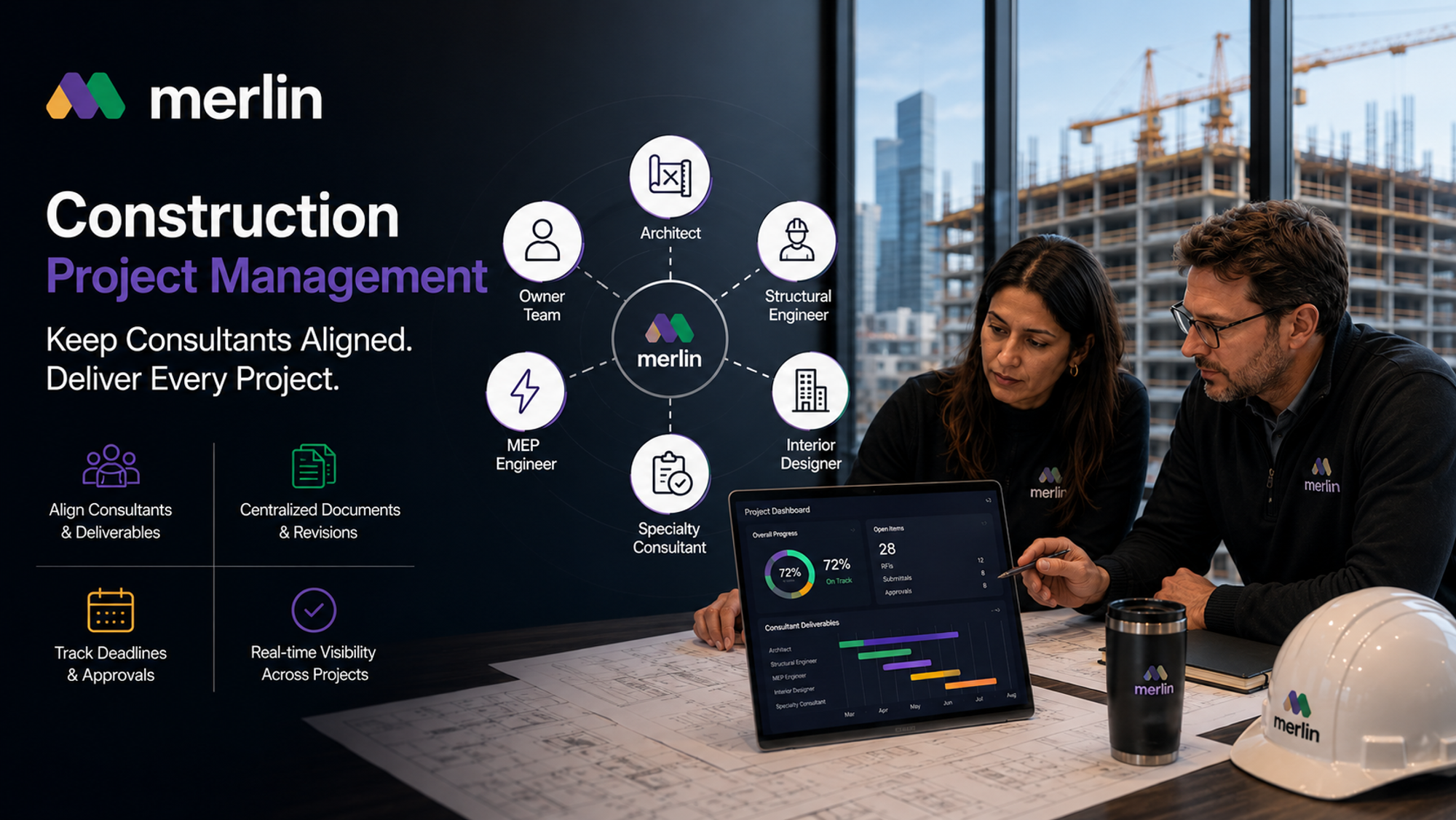
Construction owner teams rarely lose time on a project because a decision was wrong. They lose time because the right consultant never saw the question in time to answer it, or because a drawing revision sat in someone's inbox while a submittal waited on it. Multiply that across an architect, a structural engineer, an MEP consultant, and a handful of specialty reviewers, all working from their own inbox and their own file version, and even a well run project accumulates delay from coordination alone.
This is the problem construction project management software is built to solve for owner teams specifically, not contractors, not suppliers, but the owner side of the table that has to keep every consultant aligned from the first design meeting through the final closeout. Below is a closer look at why owner teams need a better way to manage consultant coordination, the features worth checking for in a coordination platform, how to actually select one, and the benefits that show up once every consultant is working from the same shared system.
Why Owner Teams Need a Better Way to Manage Consultant Coordination
Owner teams on a construction project typically coordinate with a wide range of consultants: architects, structural engineers, MEP engineers, interior designers, and often specialty consultants for acoustics, sustainability, or code compliance. Each consultant works on their own timeline, submits their own deliverables, and often uses their own tools to track progress. The owner team is left holding the pieces, expected to know at any moment which drawings are current, which submittals are pending review, and which decisions are still waiting on approval from someone else.
Owner teams researching construction and project management software are usually trying to solve this exact problem: too many consultants, too many separate threads, and no single place that shows where a project actually stands. The coordination burden only grows heavier as a project moves past design and into construction. Requests for information start flowing between the contractor and the design team. Change orders require input from whichever consultant originally specified the item in question. A single unanswered email from an engineer can hold up a submittal that a contractor needs approved before work can continue on site. When these threads live in separate inboxes rather than a shared system, an owner team has no reliable way to see where a project is actually stuck, only that it has stalled somewhere.
The cost of that lag rarely shows up as a single line item on a budget report. It shows up as a contractor idle on site waiting for an approved submittal, a permit application delayed because a consultant's stamped drawing was still sitting in review, or a change order that could have been avoided entirely if a spec question had been answered a week earlier. None of these costs get tracked back to consultant coordination specifically. They accumulate quietly as schedule slip and budget variance that nobody on the owner team can fully explain when leadership asks why a project is behind.
Many owner teams still coordinate consultants the way they did on a single small project years ago: email chains, shared drives with inconsistent file naming, and status calls that summarize where things stood a week ago rather than where they stand today. That approach can carry a small owner team through one project. It does not scale to a team running several developments at once, where the same coordination gaps multiply across every active job. Coordination failure is usually what pushes a project past its deadline, and consultant misalignment is one of the most common places that failure begins.
The project teams an owner assembles, from architects and design consultants down to design assist contractors, all need a shared point of reference for scope, schedule, and open items. Without one, the owner team becomes the default coordination layer by necessity, chasing updates instead of making decisions.
Key Features to Look for in a Consultant Coordination Platform
A consultant coordination platform is not the same thing as a general project management tool repurposed for construction. The features that matter most are the ones that keep every consultant, every deliverable, and every decision visible to the owner team without requiring someone to chase status updates manually.
The right project management software construction owner teams should start with a single shared record of every consultant assigned to a project, along with their scope, their current deliverables, and the deadlines attached to each one. That record should update automatically as work moves forward, rather than depending on someone manually rekeying status into a separate tracker.
Specification and document control matters just as much. When standardized specs reduce change orders across repeat developments, it is because everyone involved, the owner team, the consultants, and the contractor, is working from the same current version rather than an outdated file pulled from an old email thread. A platform worth adopting keeps specifications, drawings, and revisions in one place, with a clear record of who changed what and when.
Beyond documents, look for:
- A shared timeline: every consultant's deliverables mapped against the project schedule, so an owner team can see which items are on track and which are at risk before they become a delay.
- Open item tracking: a running record of requests for information, submittals, and decisions still waiting on a response, with clear ownership for each one.
- Portfolio visibility: the ability to see coordination status across every active development, not just one project at a time, for owner teams managing more than a single job.
- Role based access: consultants see what is relevant to their scope, while the owner team retains full visibility across the entire project team.
A construction project management software platform built around these features, such as the construction project management platform MerlinAI provides, gives owner teams a live picture of where a project actually stands rather than a summary that is already a week out of date by the time it reaches them.
These features work best together rather than separately. A shared timeline is only useful if it connects to the same document control system referenced in submittals, and open item tracking only closes the loop if it is tied to the same consultant records that hold scope and contact information. Owner teams that piece together separate tools for each of these needs often end up rebuilding the same coordination gap they were trying to close in the first place, just spread across more logins instead of fewer.
Selecting a Consultant Coordination Solution for Construction Owner Teams
Choosing project management software for construction projects starts with being honest about where coordination actually breaks down today. For some owner teams, the biggest gap is visibility, not knowing where a consultant's deliverable stands until it is already late. For others, it is document control, chasing down which version of a drawing is current. The right solution depends on which of these gaps is costing the most time and money right now.
It also helps to look at how other owner teams have approached similar coordination problems. Some developers are pulling procurement decisions in house rather than leaving trade partners to manage purchasing separately, for many of the same reasons that push owner teams toward centralized consultant coordination: visibility, accountability, and a single record everyone can trust. The two problems, procurement and consultant coordination, are different in the details but come from the same root cause, information spread across too many disconnected tools.
Scale matters too. A platform that works well for a single project can fall apart once an owner team is tracking progress across several developments without being able to visit every site constantly. Before committing to a solution, it is worth asking whether it was actually built to handle a portfolio of projects, each with its own consultants and its own schedule, or whether it was designed for one project and is being stretched to cover more.
Finally, weigh how much of the coordination burden a platform actually removes versus how much it simply relocates. A tool that requires an owner team to manually update project status, chase consultants for input, and reconcile conflicting file versions has not solved the underlying problem. It has just moved the same manual work into a nicer interface. The best test is whether the owner team spends less time chasing information after adopting the platform, not just whether the information technically lives in one place now.
Adoption matters as much as feature selection. A platform that sits unused by half the consultant team provides no more visibility than the spreadsheet it replaced. Before rolling out a new system, it is worth confirming that it fits into how consultants already work, submitting deliverables, responding to requests for information, tracking revisions, rather than asking them to learn an entirely new process on top of their existing workflow. The owner teams that get the most value from a coordination platform are usually the ones that involve their key consultants early, rather than presenting the system as a finished decision after the fact.
How Construction Owner Teams Benefit from Centralized Consultant Coordination
When consultant coordination runs through one connected system, the benefits show up quickly. Requests for information get answered faster because everyone can see who owns the next step, rather than a question sitting unanswered in someone's inbox. Submittals move through review without the delay of someone manually forwarding a file to the next consultant in line. Decisions get documented as they happen instead of being reconstructed from memory weeks later when a dispute comes up.
The benefit compounds for owner teams running more than one development at a time. A consistent coordination process, the kind that supports developers building multiple buildings the same way, means every new project starts from a proven structure rather than a blank page. Consultants already know how the owner team expects deliverables to be tracked and reviewed, because it is the same process they used on the last project.
Centralized coordination also gives owner teams something that scattered email threads never could: an accurate, current view of where every project actually stands. Instead of asking a project manager to summarize status ahead of a leadership review, the owner team can see it directly, updated as consultants complete their deliverables and decisions get made. That shift, from reconstructing status after the fact to seeing it live, is what separates owner teams that manage consultants well from those that spend most of their time simply trying to find out where things stand.
There is also a relationship benefit that is easy to overlook. Consultants who work with an owner team that runs a clear, consistent coordination process tend to prioritize that owner's projects, because the process itself is less frustrating than working with a team that requires constant chasing and rework. Over several projects, that reputation compounds. Reliable coordination becomes a reason a strong consultant chooses to keep working with a particular owner team ahead of other opportunities competing for the same attention.
Frequently Asked Questions
What is construction project management software for owner teams? Construction project management software for owner teams centralizes consultant coordination, document control, and project status into one connected system, replacing scattered emails, shared drives, and separate trackers with a single shared record everyone can see.
How is consultant coordination different from contractor project management? Consultant coordination focuses on the design side of a project, architects, engineers, and specialty consultants, and the deliverables, revisions, and approvals that flow between them and the owner. Contractor project management typically tracks field execution. A strong platform connects both so nothing falls through the gap between design and construction.
Can project management software construction owner teams use handle multiple projects at once? Yes, provided it was built for a portfolio rather than a single job. Owner teams managing several developments need visibility across every active project, not just the one currently in front of them, along with a consistent process that consultants can follow on each new job.
What causes the most delays in consultant coordination? Unanswered requests for information, outdated drawing versions, and decisions that were never clearly documented are among the most common causes. Most of these come down to information living in disconnected tools rather than a shared system the whole project team can see.
What should owner teams look for when evaluating project management software for construction? Look for a shared timeline for consultant deliverables, centralized document and specification control, open item tracking with clear ownership, and portfolio level visibility for teams running more than one project. A platform missing any of these still leaves a coordination gap to manage manually.