Construction RFI Management: Keeping Contractors, Consultants, and Site Work Aligned
Learn how construction RFI management helps contractors write, submit, track, and resolve RFIs while keeping consultants, procurement teams, and site work aligned.
 Sneha Kumari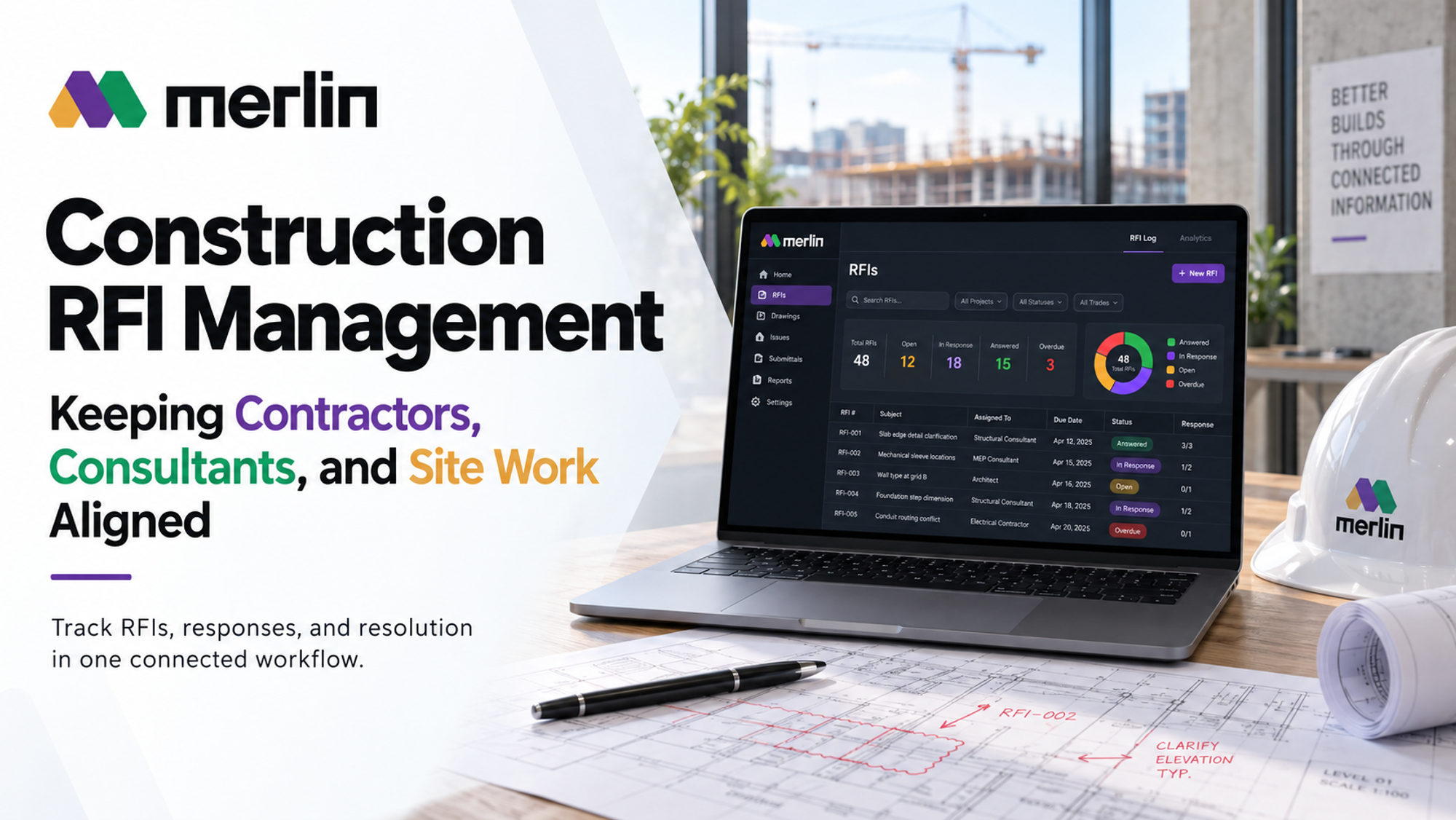
Every construction project runs on documents that are supposed to answer every question in advance, and every construction project eventually hits a question they didn't answer. That's the gap a Construction RFI exists to close. Whether it's a conflict between two drawings, a material that's no longer available, or a site condition nobody anticipated, contractors need a formal, trackable way to get a fast, accurate answer from the design team without stalling work or leaving decisions undocumented.
Handled well, construction RFI management keeps contractors, consultants, and site crews working from the same information at every stage: writing, submitting, tracking, and resolving. Handled poorly, RFIs pile up in inboxes and spreadsheets, deadlines slip, and one unanswered question on a drawing quietly turns into a delayed procurement order or an idle crew. This guide walks through what a construction RFI is, how to write one, how the process actually moves from submission to resolution, and how an RFI log and the right construction ERP software keep everyone, and every downstream decision, aligned.
What Is a Construction RFI, and Why Do Contractors Use It?
A construction RFI, or Request for Information, is a formal written question a contractor or subcontractor sends to the project's design team when drawings, specifications, or contract documents leave a gap, a conflict, or a genuine unknown. Instead of guessing at an answer or pausing work indefinitely, the field team documents the exact issue and asks the architect, engineer, or owner to provide an official response before work continues.
Contractors rely on RFIs because construction documents, however carefully prepared, rarely anticipate every real world condition. A wall section might not account for an existing utility line. A spec might list a product that's no longer manufactured. Two drawings from different disciplines might place equipment in the same physical space. When these situations surface on site, an RFI becomes the official channel for resolving them without derailing the schedule.
Construction RFIs typically get used for:
- Missing or conflicting details across drawings and specifications
- Site conditions that don't match the design documents
- Material or product substitution questions
- Coordination clashes between trades, such as mechanical, electrical, and structural
- Code or permitting questions that affect how a detail should be built
Beyond getting an answer, an RFI creates a paper trail. If a decision later affects cost or schedule, the RFI and its response show exactly what was asked, who answered, and when.
How to Write a Construction RFI: Essential Details and Practical Examples for Contractors
Writing a construction RFI comes down to including enough detail that a consultant can answer accurately on the first read, without a back and forth. A strong RFI names the exact location, references the governing document, states one clear question, and gives a deadline tied to the actual schedule impact.
Every construction RFI should include:
- RFI number and project reference, so it can be tracked and cited later
- A specific, single question: combining several issues into one RFI slows the response and risks a partial answer
- The drawing sheet, detail, or spec section the question relates to
- A photo, sketch, or markup when the issue is easier to show than describe
- A suggested resolution, if the field team has one. This gives the consultant a starting point and often speeds approval
- The date a response is needed by, tied to when the work will actually be affected
- Who submitted the RFI and which discipline or consultant it's assigned to
Example
RFI 014 Project: Riverside Medical Office Building Reference: Sheet A502, Detail 6; Sheet S201 Question: Detail 6 on A502 shows a duct transition at grid line E4, but the structural beam on S201 occupies the same clearance zone. Please confirm whether the duct should shift 6 inches north or whether the beam depth requires revision. Suggested solution: Shift ductwork north per attached sketch, pending structural confirmation. Needed by: [date], to avoid delaying HVAC rough in. Submitted by: [Contractor name]. Assigned to: Mechanical Engineer of Record.
Keep the tone factual and specific. A vague RFI such as "please clarify this detail," without a location or reason, tends to sit in a queue longer, because the consultant has to chase down what's actually being asked before they can even begin researching the answer.
The Construction RFI Process: From Submission and Consultant Response to Resolution and Implementation
The construction RFI process moves through a defined sequence: a field team identifies the issue, the contractor submits a formal RFI, the right consultant reviews and responds, and the answer gets distributed and implemented across the project. Most contracts set a response window, often 5 to 10 business days, though urgent items can be flagged for faster turnaround.
The typical stages look like this:
- Identification: A superintendent, foreman, or subcontractor spots an ambiguity, conflict, or missing detail while reviewing drawings or working in the field
- Drafting and submission: The contractor writes the RFI with full reference details and logs it in the project's tracking system
- Routing: The RFI is directed to the correct consultant based on discipline: architectural, structural, mechanical, electrical, or the owner directly if it affects scope or budget
- Review and response: The consultant researches the question, often coordinating with other design team members, and issues a formal written response
- Distribution: The response is shared with every trade and party affected, not just the one who submitted the question
- Implementation: Site work, procurement, or scheduling adjusts based on the answer
- Closure: The RFI is marked resolved and linked to any resulting drawing revision or change order
Because a single RFI can touch scheduling, budget, and multiple trades, keeping consultants and vendors informed at each stage matters as much as getting the technical answer right. Many contractors extend this same coordination discipline to managing vendor and consultant relationships across the entire project, not just during RFI review. A slow or disorganized process here is also one of the more common ways projects quietly fall behind schedule.
How Construction Contractors Manage RFI Logs, Responsibilities, and Response Deadlines
An RFI log is the master record contractors use to track every request from submission to closure: what was asked, who owns the answer, when it's due, and what happened once it was resolved. Without a reliable log, RFIs get buried in email threads, deadlines slip quietly, and crews end up waiting on answers nobody realizes are overdue.
A usable construction RFI log typically tracks:
- RFI number and short title
- Date submitted and date the response is due
- Submitted by and assigned to, meaning which consultant or discipline owns the response
- Current status: open, pending, answered, or closed
- Whether the item carries a cost or schedule impact
- Linked drawings, spec sections, or photos
- A summary of the response and the closure date
Responsibility is the part that breaks down most often on paper based systems. A spreadsheet log can show that an RFI is open, but it rarely shows clearly enough who is actually accountable for the next move, or flags it automatically when a deadline is approaching. That gap is why many contractors and consultants now work from a shared, single source of truth instead of separate spreadsheets and inboxes, so office staff, consultants, and site teams are all looking at the same live status.
Regardless of the tool, the discipline that matters is the same: every open RFI needs a named owner, a visible due date, and an escalation path if that date passes without a response.
The Impact of RFI Decisions on Procurement, Project Costs, and Site Work
RFI decisions rarely stay contained to the question that was asked. A clarification on one detail can change a material spec, a quantity, or a lead time, and that change ripples directly into procurement, budget, and whatever the crew is doing on site that week.
Consider how a single answer travels through a project:
- Procurement: A material substitution confirmed through an RFI might require reissuing a purchase order, rechecking supplier lead times, or reconfirming pricing before the order can move forward
- Project costs: An RFI that takes weeks instead of days to answer can idle a crew, trigger standby time, or force a temporary workaround that later needs to be redone. Even a routine RFI carries administrative cost in the hours spent drafting, tracking, and reviewing it
- Site work: Crews may need to pause a specific task, sequence around the open item, or proceed at risk while waiting on the official answer, none of which are ideal for keeping a schedule intact
A duct routing conflict, for example, might require an updated fabrication order with the sheet metal supplier before installation can continue. A question about rebar spacing in a foundation might hold up a concrete pour until structural confirmation arrives. These are the kinds of downstream effects that make construction procurement workflows and RFI management inseparable in practice, even though they're often handled as separate processes.
Connecting Construction RFI Management With Procurement and Site Execution Through an ERP Platform
Construction RFI management works best when it isn't isolated from procurement, scheduling, and budgeting. A construction ERP software platform connects these pieces so that resolving an RFI automatically flags the purchase orders, tasks, or budget lines it affects, instead of relying on someone to remember to update three or four separate systems by hand.
What this looks like in practice, within a construction RFI management software module built into an ERP:
- A centralized RFI log tied directly to drawings, spec sections, purchase orders, and schedule tasks, so the connection between a question and everything it touches is visible in one place
- Automatic notifications and escalation as a response deadline approaches, rather than relying on someone to check a spreadsheet
- Shared, real time visibility for contractors, consultants, and site teams, so nobody is working from an outdated version of the answer
- Direct links between RFI resolution and procurement, so an affected purchase order is flagged the moment an answer changes a material or quantity
- A complete audit trail that supports cost tracking, claims, and disputes if a decision is questioned later
This is the core idea behind a purpose built construction ERP platform: RFIs, procurement, scheduling, and financials sit in one connected system instead of eight or more disconnected tools. As more of this coordination gets handled by AI powered construction management platforms, the manual chasing that used to define RFI tracking becomes far less of the job, freeing contractors and consultants to focus on the actual technical questions in front of them.
Frequently Asked Questions
What is the difference between an RFI and a submittal in construction?
An RFI asks a question to clarify something unclear, missing, or conflicting in the project documents. A submittal is a different type of document, such as a shop drawing, product data sheet, or material sample, submitted for the design team's approval before a product is ordered or installed. RFIs resolve uncertainty; submittals confirm that a specific product or method meets the design intent.
How long should a consultant take to respond to a construction RFI?
Most construction contracts specify a response window, commonly 5 to 10 business days, though this varies by project and contract type. Time sensitive items that could halt work should be clearly flagged as urgent so they're prioritized ahead of routine questions, and the requested response date should reflect when the answer is actually needed on site rather than a generic deadline.
Who is responsible for tracking RFI logs on a project?
The general contractor typically owns the master RFI log, since they're coordinating input from every subcontractor and routing questions to the right consultant. That said, architects, engineers, and owners usually keep their own tracking as well, which is why a shared log that all parties can see reduces the risk of conflicting records.
Can an RFI lead to a change order?
Yes. If the answer to an RFI changes the scope, cost, or schedule of the work, such as a material substitution or a design revision, it often results in a change order to formally document and price that change. Not every RFI leads to one, but any RFI with a cost or schedule impact should be flagged for review before work proceeds.
What construction RFI management software features should contractors look for?
Look for a centralized log with automatic status tracking, deadline reminders and escalation, direct links between RFIs and the drawings, purchase orders, or schedule tasks they affect, and real time access for every contractor, consultant, and site team involved. Software that connects RFI management to procurement and budgeting, rather than treating it as a standalone log, gives a more accurate picture of how open questions are actually affecting the project.