Construction Supply Chain Management Software: How to Connect Procurement, Materials, and Delivery
Learn how construction supply chain management software connects procurement, materials, and delivery to improve visibility, reduce delays, control costs, and keep projects on schedule.
 Sneha Kumari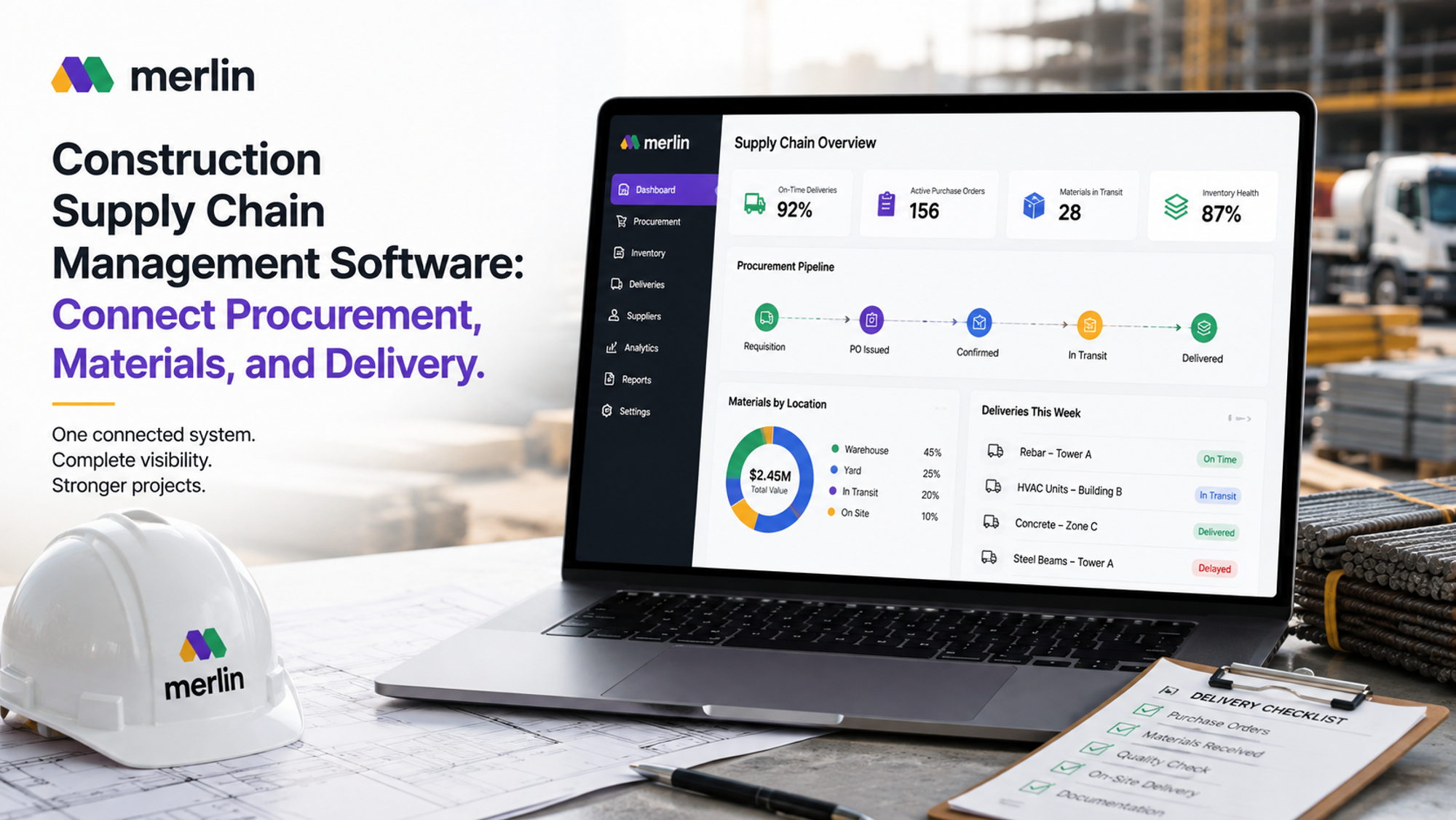
Most construction projects don't fall behind because of bad weather or a difficult client. They fall behind because a purchase order sat unapproved for three days, a delivery arrived at the wrong gate, or nobody on site knew that the rebar shipment had already left the yard. These are not scheduling problems. They are supply chain problems, and they show up on almost every project where procurement, materials, and delivery are managed as three separate jobs instead of one connected process.
Construction supply chain management software exists to close that gap. This guide covers what the software actually is and how it works, why disconnected procurement and material data quietly drains budgets and timelines, what a properly connected construction supply chain looks like in practice, how technologies like AI, IoT, RFID, and GPS are changing material tracking and site logistics, the real difference between standalone tools and ERP integrated platforms, and how just in time delivery changes the economics of a project when it is supported by the right system.
What Is Construction Supply Chain Management Software and How Does It Work?
Construction supply chain management software is a digital system that connects procurement, material tracking, and delivery logistics into one continuously updated workflow, rather than treating them as separate tasks handled by separate teams using separate tools. In practice, this means a purchase order created in the office, a stock count in the yard, and a delivery schedule for the job site all reference the same underlying data, instead of living in three spreadsheets that never quite agree with each other.
At a functional level, construction supply chain software works by centralizing four layers of information that most contractors and suppliers still manage manually:
- Procurement: requests for quotes, purchase orders, supplier approvals, and contract pricing, tied directly to project budgets and schedules
- Materials management: live inventory across warehouses, yards, and active job sites, along with bills of materials and stock allocation per project phase
- Logistics and delivery: scheduling, routing, load planning, and proof of delivery, so office and site teams see the same delivery status
- Reporting and alerts: dashboards that flag late purchase orders, low stock, or delivery delays before they affect the schedule
When these layers are connected rather than siloed, a single action, like receiving a shipment, automatically updates inventory, project budgets, and the site schedule at the same time. This is also why supply chain visibility has become a core part of broader construction project management platforms rather than a standalone concern: materials and delivery status directly determine whether a schedule is realistic or aspirational.
Why Disconnected Procurement, Material, and Site Data Creates Construction Supply Chain Problems
Disconnected procurement, material, and site data creates construction supply chain problems because decisions get made on information that is already out of date by the time anyone acts on it. A purchasing manager approving a reorder has no idea the site already has excess stock. A superintendent reporting a "material shortage" may simply be missing the memo that the delivery already happened and was logged under the wrong project code.
The most common problems this creates include:
- Duplicate and delayed data entry: the same purchase order gets typed into an accounting system, a spreadsheet, and a supplier portal, and each version drifts slightly from the others.
- Purchase orders disconnected from real site needs: procurement orders based on the original estimate rather than what has actually been installed, leading to over ordering or last minute shortages.
- No visibility into material location: nobody can say with confidence whether a shipment is still at the supplier, in transit, sitting in the yard, or already on site.
- False "missing material" delays: crews sit idle waiting for materials that technically arrived, just not where or when anyone expected.
- Emergency purchases and rush freight: when visibility fails, teams overcorrect by rush ordering at a premium, quietly eating into margin.
- Friction between procurement and site teams: each side blames the other for delays that are really caused by a lack of shared data, not a lack of effort.
None of these are dramatic failures on their own. The real damage is cumulative, which is exactly why the hidden costs of running disconnected systems tend to be underestimated until someone actually adds up the wasted hours, rush freight charges, and rework across a full project.
Connecting Procurement, Materials, and Delivery Through a Unified Construction Supply Chain
Connecting procurement, materials, and delivery means routing every purchase, every stock movement, and every shipment through one shared system, so that a change in one area is instantly reflected in the other two. Instead of procurement, the warehouse, and the site operating on their own timelines, they operate on one timeline built around the project schedule itself.
In a properly unified construction supply chain, the workflow generally follows six connected stages:
- Demand signal: a project schedule or site request identifies what materials are needed and when, based on actual phase progress rather than the original estimate alone.
- Purchase order creation: procurement generates a purchase order tied to that specific project and phase, with pricing pulled from existing supplier agreements.
- Receiving and verification: materials are checked in against the purchase order when they arrive at a warehouse or yard, updating inventory automatically.
- Allocation: received stock is allocated to the specific project and phase that requested it, rather than sitting as unassigned inventory.
- Delivery scheduling: materials are routed to the site based on the construction schedule, not just supplier availability.
- Site confirmation: the site team confirms receipt, closing the loop and updating both inventory and the project cost ledger in real time.
This is the same principle behind why more contractors are formalizing their own material operations. As one recent breakdown of connecting procurement, receiving, inventory, and delivery in a single workflow points out, a warehouse only becomes a genuine advantage once purchase orders flow directly from project demand rather than from habit or guesswork. The same logic applies to any contractor or supplier trying to bring materials, labour, and cost management under one roof: the goal is one continuously updated picture, not three reports that get reconciled after the fact.
How AI, IoT, RFID, and GPS Are Transforming Material Tracking and Construction Site Logistics
AI, IoT, RFID, and GPS are transforming material tracking and construction site logistics by replacing manual counts and phone call updates with continuous, automated data. Instead of someone walking the yard with a clipboard, sensors and software report material location, condition, and movement as it happens.
Each technology plays a distinct role:
- Artificial intelligence: analyzes historical usage and current project data to forecast material demand, flag purchase orders that are likely to arrive late, and trigger automatic reorder suggestions before a shortage actually occurs.
- IoT sensors: monitor conditions like temperature, moisture, and humidity for materials that are sensitive to weather exposure, and track stock levels in yards or containers without manual counts.
- RFID tagging: attaches a trackable identifier to pallets, bundles, or equipment, allowing the system to confirm exactly when material left the warehouse, arrived on site, or moved between storage areas, which also reduces loss and theft.
- GPS tracking: follows delivery vehicles in real time, giving accurate estimated arrival times instead of a rough delivery window, and allows dispatchers to reroute around traffic, weather, or site access issues.
Together, these tools shift material tracking from a reactive activity, where problems are discovered after the fact, to a proactive one, where the system surfaces a likely delay while there is still time to act on it. The same shift is already well underway on the safety side of construction, where AI powered wearables and sensors are used for real time, predictive monitoring rather than periodic manual inspection. Material logistics is following the same trajectory: continuous sensing plus predictive software, in place of spreadsheets updated once a day.
Standalone vs. ERP Integrated Construction Supply Chain Software: What's the Difference?
The difference between standalone and ERP integrated construction supply chain software comes down to where the data lives. Standalone tools handle procurement, inventory, or logistics as a dedicated application that then has to be connected, usually through integrations or manual exports, to the rest of the business. ERP integrated software handles the same functions natively inside a broader platform that also runs scheduling, finance, and project management, so there is nothing separate to connect in the first place.
Standalone construction supply chain software tends to make sense when:
- A company needs a specific capability quickly, such as a dedicated inventory app or a delivery tracking tool, without a full platform rollout
- Existing accounting or project management systems are already well established and only need a narrow add on
- The team is small enough that manual reconciliation between systems is still manageable
ERP integrated construction supply chain software tends to make more sense when:
- Procurement, materials, and delivery data need to update budgets, schedules, and reporting automatically, without someone exporting and re importing spreadsheets
- The business is scaling across multiple projects, warehouses, or locations, where inconsistent standalone tools quickly become unmanageable
- Leadership wants one accurate, current view of project cost and material status, rather than several partial views that need to be manually reconciled
The trade off is straightforward: standalone tools are usually faster and cheaper to adopt individually, but every additional standalone tool adds another handoff, and another place for information to fragment. A purpose built ERP for construction avoids that fragmentation by design, which is part of why sectors with especially complex logistics, such as modular and prefabricated building, have leaned so heavily into ERP driven supply chain coordination rather than stitching together separate procurement, inventory, and scheduling tools after the fact.
Just in Time Delivery in Construction: How It Affects Project Timelines, Material Costs, and Site Productivity
Just in time delivery in construction means scheduling materials to arrive exactly when a crew is ready to use them, rather than stockpiling weeks of inventory on site in advance. Done well, it reduces double handling, storage costs, and site congestion. Done without accurate coordination, it can stop a crew cold the moment a single delivery slips.
The effects show up in three areas:
- Project timelines: just in time delivery keeps a schedule moving efficiently when it works, because crews are never waiting on backlogged inventory decisions. But it also removes the buffer that a stockpile used to provide, so a late truck now has a direct, immediate impact on the day's work rather than being absorbed by existing on site stock.
- Material costs: carrying less inventory on site reduces storage costs, waste from damaged or misplaced stock, and the capital tied up in materials sitting unused for weeks. The trade off is that smaller, more frequent deliveries can mean higher transport costs per load if routing and scheduling aren't optimized.
- Site productivity: crews spend less time searching for, moving, or working around large stockpiles of material, and site layout stays cleaner and safer. This only holds true, however, if delivery timing is reliable enough that trades can plan their sequencing around it with confidence.
The common thread across all three is that just in time delivery is a coordination strategy, not just a delivery strategy. It depends on the same procurement, inventory, and scheduling data working together, which is also why coordinating subcontractor schedules and delivery windows has become as much a supply chain discipline as it is a site management one. Without that coordination, just in time delivery simply moves the risk of a stockout from the yard to the truck.
Procurement, materials, and delivery were never really three separate problems. They only look that way when they're managed in three separate systems. Bringing them into one connected construction supply chain, supported by real time tracking technology and the right software architecture for your business, is what turns material logistics from a daily source of delay into a source of schedule reliability and cost control.
Frequently Asked Questions
What is the difference between construction supply chain management and traditional supply chain management?
Supply chain management in construction deals with project based, temporary, and often mobile job sites, custom bills of materials for each build, and delivery schedules that shift with weather and site progress. Traditional manufacturing or retail supply chains are usually built around fixed warehouses, repeatable production runs, and predictable delivery points, which makes them easier to standardize than a construction supply chain that changes with every new project.
What features should I look for in construction supply chain management software?
Look for real time inventory visibility across warehouses and job sites, purchase order tracking from request through delivery, mobile access for site teams, integration with accounting or ERP systems, GPS enabled delivery tracking, and reporting that flags delays or shortages before they affect the schedule. The right combination depends on whether you need a standalone tool or a fully integrated platform.
Can construction supply chain software integrate with my existing accounting or ERP system?
Most modern construction supply chain software offers integrations or open APIs, though the depth of that integration varies. Standalone tools typically require a separate integration project to sync with accounting or project management systems, while ERP integrated platforms already share the same underlying database, so procurement, materials, and delivery data update finance and scheduling automatically.
How is construction material logistics different from logistics in manufacturing or retail?
Construction material logistics involves delivering to temporary, often changing site locations with limited storage, variable access, and weather exposure, and coordinating deliveries in phases that match the build sequence. Manufacturing and retail logistics generally move goods to fixed, permanent locations with consistent receiving processes, which makes routing and scheduling considerably more predictable.
Does just in time delivery increase the risk of delays on construction projects?
It can, if it isn't backed by accurate scheduling, reliable suppliers, and real time delivery tracking, since there is little or no on site stock buffer to absorb a late shipment. When it is supported by connected procurement, inventory, and logistics software that gives advance warning of delays, just in time delivery generally reduces overall risk by cutting down on the miscommunication and guesswork that cause most site delays in the first place.