The Intersection of Technology and Construction: Operational Intelligence Explained
Learn how construction operational intelligence uses real time data to improve production performance, reduce delays, and optimize factory operations.
 Sneha Kumari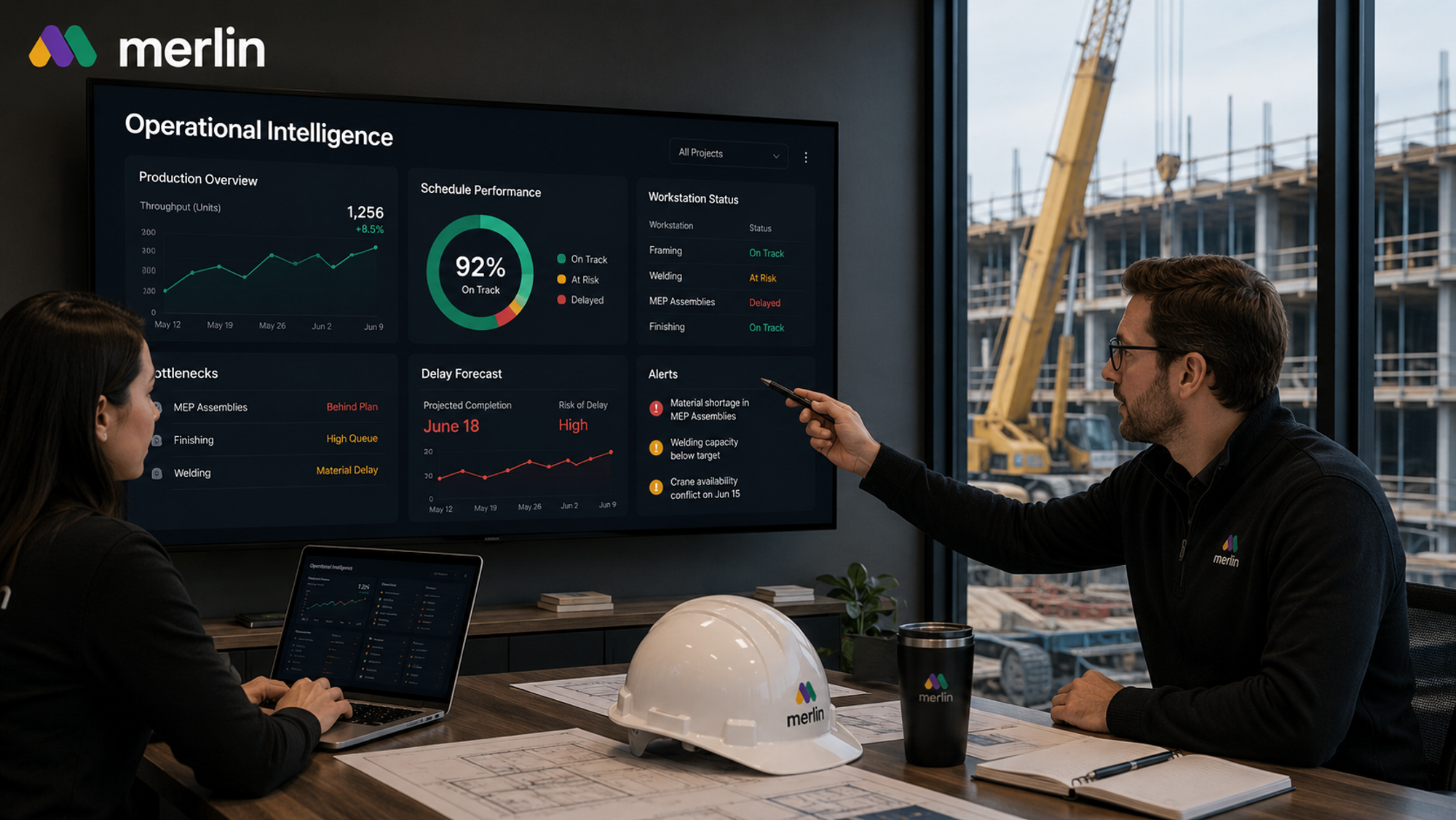
Construction has never lacked data. Every project generates schedules, work orders, material logs, labor hours, and inspection reports. What it has lacked is a way to turn that data into decisions while there is still time to act on them. That gap is exactly where operational intelligence sits, at the point where technology stops just recording construction work and starts actively improving it.
This post breaks down what construction operational intelligence actually means, how it helps teams catch bottlenecks and forecast delays before they become expensive, why the reporting most builders already use falls short of this standard, and how a system like Merlin PI turns raw operational data into intelligence that production teams can act on the same day it is generated.
What Is Construction Operational Intelligence? How Does It Improve Production Performance?
Operational intelligence in construction refers to the use of live operational data, pulled from scheduling, production, materials, and labor systems, to give teams a continuous, current picture of how work is actually progressing, rather than a picture based on what was planned weeks ago.
The distinction matters. Traditional construction management tracks plans: budgets, schedules, and scopes set at the start of a project. Operational intelligence tracks execution: what is actually happening on the shop floor and the job site right now, and how that reality compares to the plan.
For production performance specifically, this shift changes what teams can see and when they can see it.
Instead of learning about a capacity shortfall at the end of a production run, operational intelligence surfaces it while there is still time to rebalance labor or adjust the schedule. Instead of discovering a material shortage when a crew is already standing at an empty rack, it flags the shortfall while there is still a lead time window to reorder. Instead of comparing planned versus actual output only at project close, it tracks that variance continuously, so small slippages get caught before they compound into missed delivery dates.
In practical terms, operational intelligence turns three previously disconnected activities, monitoring, analysis, and response, into a single continuous loop. Data comes in from the floor and the field, gets analyzed against expected performance, and produces a specific, actionable signal, not just a report to review later.
How Operational Intelligence Helps Detect Bottlenecks, Forecast Delays, and Improve Factory Performance
Bottlenecks and delays rarely appear out of nowhere. They build up gradually, through small variances that are individually easy to dismiss but collectively significant. Operational intelligence is built specifically to catch that build up.
Detecting bottlenecks as they form. Rather than waiting for a station to visibly back up, operational intelligence tracks throughput at each stage of production against its expected rate. When one stage starts trending below capacity, even before output actually stalls, the system flags it. This gives supervisors time to reallocate labor or adjust sequencing before the slowdown reaches downstream stations.
Forecasting delays before they happen. By comparing current production velocity against the remaining scope and the committed delivery date, operational intelligence can project whether a run is on track to finish on time, not just whether it is currently behind. This turns delay management from reactive firefighting into proactive adjustment.
Connecting factory performance to site impact. A slowdown in the factory does not stay contained to the factory. Operational intelligence links production status to downstream construction milestones, so a factory delay automatically surfaces as a flag on the site schedule, rather than being discovered only when a delivery fails to arrive.
Surfacing root causes, not just symptoms. Good operational intelligence does not stop at flagging that output dropped. It correlates the drop against labor availability, material readiness, equipment downtime, and other variables to point toward the actual cause, which is what makes the alert genuinely actionable rather than just a warning.
This is the core difference between having data and having intelligence. Data tells you what happened. Operational intelligence tells you what is about to happen and gives you a specific reason why.
Why Traditional Construction Reporting Isn't Enough for Modern Production
Most construction and manufacturing teams already produce reports. Weekly production summaries, monthly cost reports, end of phase schedule reviews. The problem is not a lack of reporting. It is that traditional reporting was designed for a slower, more linear era of construction, and modern production has outgrown it.
Reports describe the past. By the time a weekly production report is compiled, reviewed, and discussed, the conditions it describes are already several days old. Any corrective action taken from that report is inherently delayed.
Reports are static snapshots. A report captures a single point in time. It cannot show a supervisor that a bottleneck is actively forming right now, only that output was lower than planned last week.
Reports are siloed by function. Production reports live with the factory. Site progress reports live with the project manager. Financial reports live with accounting. Each shows part of the picture, but connecting them into a single operational view is usually a manual, after the fact exercise, if it happens at all.
Reports rely on someone reading them. Even a well built report only creates value if the right person reviews it in time to act. Operational intelligence removes that dependency by pushing alerts and forecasts directly to the people who need them, rather than waiting for a scheduled review.
None of this means reporting is obsolete. Reports remain useful for retrospective analysis, compliance, and communicating progress to stakeholders. But as a tool for actively managing production performance in real time, static reporting simply cannot keep pace with how fast modern, technology enabled construction moves. This is the core argument for smart construction management systems that operate continuously rather than on a reporting cycle.
How Merlin PI Turns Operational Data into Actionable Production Intelligence
Merlin PI is built around the idea that raw operational data only becomes valuable once it is connected, analyzed, and delivered as a specific, timely signal. Rather than collecting production and site data into another static dashboard, Merlin PI works as a continuous layer across production and construction execution.
Unified data ingestion. Merlin PI pulls in data from production scheduling, material tracking, labor logs, and site milestones, so performance is measured against one connected picture instead of fragments across separate systems.
Continuous variance tracking. Instead of comparing planned versus actual only at set checkpoints, Merlin PI tracks that variance continuously, which is what allows it to catch a developing bottleneck days before it would show up in a traditional end of week report.
Predictive delay signals. By modeling current velocity against remaining scope, Merlin PI can flag when a production run or site milestone is trending toward a missed date, giving teams a real window to adjust rather than a notification after the fact.
Actionable alerts over passive dashboards. The system is designed to push specific, contextual alerts, such as which station is trending below capacity and why, rather than requiring someone to interpret a chart and decide what it means.
Bridging factory and field. Because Merlin PI connects production status to site milestones, a factory side delay is reflected automatically in the construction schedule, closing one of the most common gaps in offsite and hybrid construction delivery.
For teams looking to understand how this fits into a broader operations stack, our overview of the Merlin platform covers how production intelligence connects to estimating, materials, and project management in one system. Teams specifically managing offsite production alongside site delivery may also find our piece on keeping shop production aligned with jobsite delivery useful as a companion read.
Frequently Asked Questions
Is operational intelligence the same thing as business intelligence? Not exactly. Business intelligence typically analyzes historical data to support strategic decisions over longer time horizons. Operational intelligence focuses on live, in the moment data to support immediate operational decisions, such as reallocating labor on the same shift a bottleneck appears.
Does operational intelligence require replacing existing construction software? Not necessarily. Many operational intelligence systems are designed to pull data from existing scheduling, ERP, and production tools rather than replace them outright, though the level of integration required depends on the specific systems already in place.
How quickly can operational intelligence detect a production bottleneck? This depends on how frequently data is captured and analyzed, but systems built for continuous monitoring can typically flag a developing bottleneck within hours of throughput beginning to trend below expected rates, rather than waiting for a weekly report cycle.
Is operational intelligence only useful for large construction operations? No. While large multi-site operations have the most data to manage, smaller builders and single factory operations benefit just as much from catching material shortages or capacity issues early, since a delay has proportionally larger impact on a smaller pipeline of work.
What is the biggest barrier to adopting operational intelligence in construction? The most common barrier is not technology but data fragmentation, where production, materials, labor, and site data live in separate systems that were never designed to talk to each other. Addressing that connection is usually the first step before any predictive capability becomes possible.