Product Data Management for Building Products: Keeping Specifications, Quotes, and Purchase Orders Aligned
Learn how product data management helps building product suppliers keep specifications, technical documents, RFQ responses, quotes, product revisions, and purchase orders aligned.
 Sneha Kumari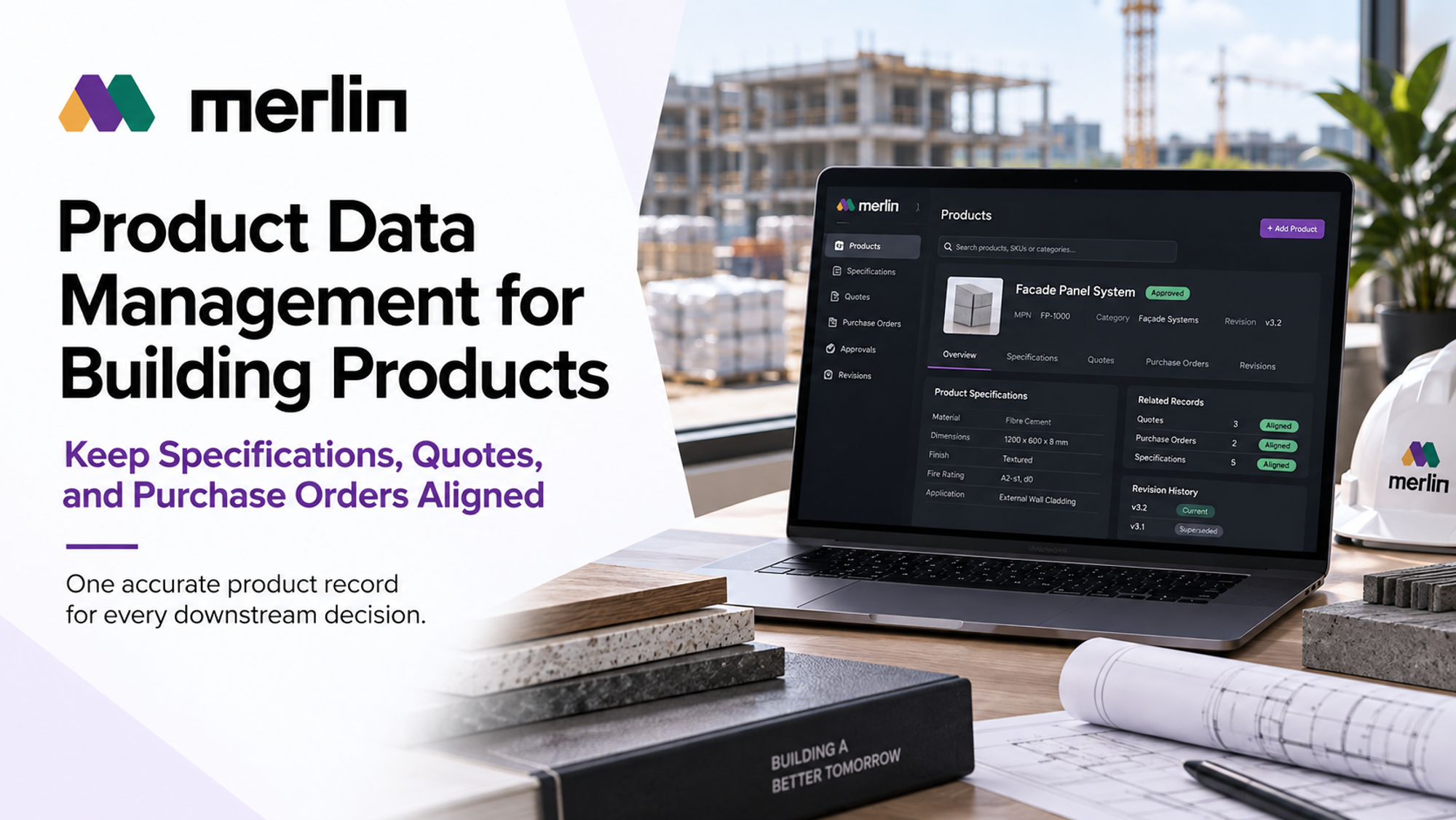
A building product supplier can have an accurate spec sheet, a competitive price list, and a reliable production line, and still lose a bid or a customer over something simpler: three different departments quoting three different versions of the same product. This is the practical reality behind product data management for building products. It is not a filing exercise. It is what keeps the specification an architect approves, the quote a sales rep sends, and the purchase order a contractor signs all describing the same thing.
For manufacturers and suppliers selling into construction, and for the procurement teams buying from them, the gap between what was specified and what actually gets quoted and delivered is where most sourcing delays, change orders, and disputed invoices start. This post walks through what Product Data Management actually covers, where the disconnect between design and procurement usually begins, and what it takes to keep specifications, RFQ responses, purchase orders, and approved product selections aligned as a project moves from design to delivery.
What Is Product Data Management, and Why Does It Matter for Building Product Suppliers?
Product Data Management (PDM) is the practice of maintaining one accurate, current record for every product a supplier makes or sells, so that sales, engineering, procurement, and production are all working from that record rather than from a dozen slightly different copies of it. For a building product supplier, this means the specification an architect reads, the price a sales rep quotes, and the certificate a contractor files at inspection all trace back to the same source.
It matters because building products rarely stay still. Materials get substituted, lead times shift with supply conditions, codes get updated, and pricing changes by quarter or by project volume. Without a shared system, each department keeps its own version of the truth: engineering has the latest spec sheet, sales has last quarter's price list, and the field has whatever PDF someone emailed six months ago.
A supplier with strong product data management can answer a basic question in seconds: what is the current, correct version of this product, and who has already been told something different. That single capability is what keeps RFQ responses accurate, purchase orders defensible, and construction technical documentation trustworthy across a project's life.
At minimum, PDM for a building product business should cover:
- Specifications and dimensional data for every SKU
- Technical documents: spec sheets, compliance certificates, warranty terms, installation guides
- Pricing, by customer tier and by project
- Revision history, so anyone can see what changed and when
- Approved substitutions and equivalents
Suppliers that treat this as a connected system, rather than a shared drive full of PDFs, are the ones that respond to RFQs faster and get fewer callbacks about mismatched deliveries. A connected operational layer like Merlin AI's construction ERP platform is built around exactly this problem: keeping one product record that every downstream document, quote, submittal, or purchase order, pulls from automatically.
Disconnect Between Design and Procurement: The Core Challenge
The core challenge construction buyers and project delivery teams face is timing: the product data used to design and specify a project is captured at one moment, but procurement acts on it weeks or months later, by which point the product may have changed, been discontinued, or simply been priced differently. The gap between those two moments is where most sourcing problems start.
This shows up in familiar ways. An architect specifies a product from a catalog PDF that is two revisions out of date. A procurement team builds an RFQ from a spreadsheet nobody updated after the supplier's last price change. A site team receives a delivery that technically satisfies the original spec but not the version the design team actually approved. None of these are large failures on their own, but together they are why change orders, reissued purchase orders, and last minute substitutions are so common on building projects.
Common symptoms of this disconnect include:
- RFQs that reference model numbers no longer in production
- Technical submittals built from outdated cut sheets
- Approved product lists that do not match what a supplier can actually deliver on schedule
- Quotes that need to be revised more than once before a purchase order can be issued
Closing this gap is less about better communication and more about removing the handoffs where drift happens. Project teams that run sourcing through Merlin AI's plans for construction procurement teams keep the specification, the RFQ, and the eventual purchase order tied to the same underlying product record, so a change made in one place is visible everywhere else immediately.
Keeping Product Specifications, Technical Documents, and Catalogues Accurate and Accessible for Contractors and Procurement Teams
Keeping specifications, technical documents, and catalogues accurate means treating every product as a living record with one owner, one current version, and a visible history, rather than a static file that gets copied and forwarded until nobody is sure which copy is correct.
Accuracy alone is not enough if the information cannot be found. Contractors and procurement teams need to reach the current version of a spec without emailing a sales rep and waiting a day for a reply. That requires structured, searchable building product specifications rather than a folder of PDFs named by date.
Practices that keep this reliable in day to day use:
- Assign a single owner for each SKU's data, so updates happen in one place
- Timestamp every revision and retire outdated versions instead of leaving them accessible
- Publish current specs and construction technical documentation through a portal or catalogue contractors can search directly
- Tag documents against the requirements they satisfy: fire rating, structural load, warranty term, regional code compliance
When this is missing, procurement teams often fall back on whatever spec was attached to the original bid package, even after it has been superseded. That is how a contractor ends up ordering a product that technically matches an old drawing but not the version currently in production, a mismatch that usually surfaces at the worst possible time: during delivery or inspection.
How to Use Reliable Product Data to Prepare RFQ Responses and Project Quotes
Reliable product data lets a supplier respond to an RFQ with a quote that matches what was actually specified, priced correctly, and available on the timeline promised. That is what cuts the back and forth that otherwise stalls a procurement cycle for days or weeks.
The process breaks down when the data behind it is not current. An RFQ arrives referencing a specific product and configuration, and the person preparing the quote pulls pricing from one file, technical data from another, and lead time from memory or a phone call to production. Each of those sources can be out of date independently, and the quote inherits every one of those gaps.
Common failure points in RFQ responses:
- Quoting from a price list that has not caught up with a recent cost change
- Missing an updated lead time caused by a material shortage or supplier delay
- Attaching technical documents for a similar product rather than the exact configuration requested
- Leaving out a required substitution note when the specified SKU is not currently available
A more reliable process looks like this:
- Pull specifications, pricing, and lead time from one connected system rather than several spreadsheets
- Check the RFQ's referenced specification against the current approved revision before quoting
- Attach the exact technical documents for the configuration being quoted, not the closest match on file
- Flag any substitution clearly, with the reasoning, rather than quoting silently against a different product
Manufacturers that run quoting this way, supported by systems such as the Merlin AI construction ERP platform, tend to find their first quote is usually their last, because it was accurate the first time.
Managing Product Revisions: Keeping Approved Selections and Purchase Orders Aligned
Managing product revisions well means every change to a product, whether a material substitution, a price update, or a compliance change, is tracked against every approved product selection and every open purchase order tied to that product, rather than corrected manually after someone notices a mismatch.
The risk is straightforward: once a product has been approved through submittals and a purchase order has been issued, any later revision to that product creates a fork. If the revision is not tracked back to the open PO, a contractor may install a product against an outdated spec, an invoice may not reconcile against what was ordered, or an inspector may flag a certificate that no longer matches the product actually delivered.
Keeping approved selections and purchase orders aligned through a revision generally requires:
- Version numbers tied directly to each purchase order, so the exact revision ordered is never ambiguous
- Automatic flags when a revision affects a product tied to an open PO or an approved submittal
- A change log connecting the approved selection, the RFQ history, and the current production version of the product
This is where product data management earns its keep on a live project. A revision to a single SKU can touch a design approval from months earlier, several open purchase orders, and an invoice reconciliation in progress, all at once. Systems that surface those connections automatically catch the mismatch before it reaches the job site, rather than after. For a closer look at how this stays connected in practice, Merlin AI's construction FAQs answer common questions about how revisions, quotes, and purchase orders stay tied together inside the platform.
Connecting Supplier Sales and Construction Procurement Through Shared Product Information
Connecting supplier sales and construction procurement means both sides work from the same product information: the same specifications, the same pricing, the same revision history, instead of each side maintaining its own version and reconciling the differences after the fact.
This is the practical goal of supplier product information management: closing the loop between what a sales team quotes, what a design team specifies, and what a procurement team eventually orders and pays for. When those three views of a product are backed by the same record, discrepancies between a supplier's quote and a contractor's purchase order become the exception rather than something every accounts payable team budgets time for.
Elements worth connecting directly:
- CRM and quoting tools that read from the same master product records used by engineering and production
- Procurement systems that pull live specifications rather than cached copies attached to an old bid
- Purchase orders that reference the same SKU and revision identifiers used in the original specification and quote
For suppliers and contractors working through how this fits together operationally, the Merlin AI blog's construction operations resources cover related ground on procurement, scheduling, and supplier management.
Frequently Asked Questions
What is product data management in construction procurement?
It is the practice of keeping one accurate, current record for each product, covering specifications, technical documents, pricing, and revision history, so that design, procurement, and delivery all reference the same information instead of separate copies.
Why do product specifications change between design approval and delivery?
Products change for ordinary business reasons: material substitutions, updated codes, pricing adjustments, or a manufacturer discontinuing a SKU. The problem is not that specifications change, it is that most projects have no reliable way to push that change back to every quote and purchase order already tied to the original version.
How can building product suppliers keep RFQ responses accurate?
By pulling pricing, technical documents, and lead times from one connected product record rather than separate spreadsheets, checking the RFQ against the current approved specification before quoting, and flagging substitutions explicitly rather than quoting against a different product without saying so.
What happens when a purchase order does not match the approved product specification?
It usually surfaces late, either at delivery when the product does not match what the field expected, or at invoicing when the paperwork does not reconcile. Both outcomes cost time, and both are avoidable if the purchase order references the same revision as the approved selection.
How does supplier product information management reduce procurement delays?
It removes the need to recreate product information at every stage of a deal. When sales, procurement, and production all read from the same specifications and pricing, quotes take less time to prepare, RFQ responses need fewer revisions, and purchase orders rarely need to be reissued because of a data mismatch.