What Is Supplier Life Cycle Management? A Guide to Supplier Lifecycle Management Software
Learn how supplier life cycle management helps construction companies manage suppliers from identification and qualification through onboarding, performance tracking, and offboarding.
 Sneha Kumari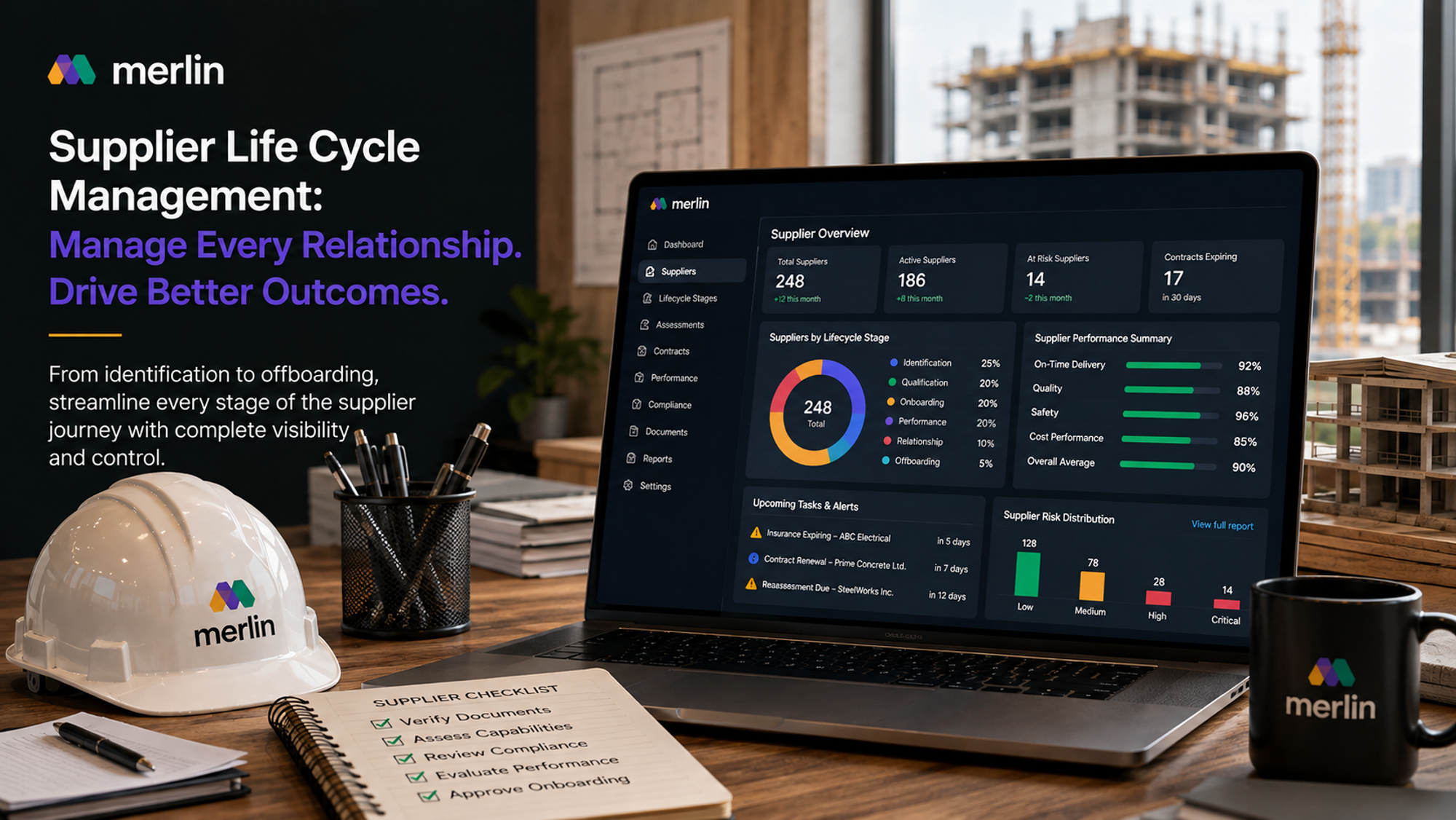
A construction company might work with dozens, sometimes hundreds, of suppliers across a single programme of projects, and yet most of that knowledge lives in whoever happened to onboard each one. The insurance certificate that expired last month, the trade partner who did excellent work on one job and then missed three deadlines on the next, the supplier who was never formally taken off the bid list even after the relationship ended badly: all of it is usually scattered across inboxes and individual memory rather than tracked anywhere central.
Supplier life cycle management is the discipline that fixes this, and supplier lifecycle management software is the tool that makes it practical at scale. Rather than treating each supplier relationship as a fresh start, both approach a company's full supplier base as something worth managing deliberately, from the moment a supplier is first identified through to the day the relationship ends. The alternative, treating every relationship as a clean slate each time, is expensive in ways that rarely show up on a single project's budget but add up considerably across a full portfolio.
This guide covers what supplier life cycle management actually means and how it differs from supplier relationship management, the six stages most versions of it are built around, what to expect from dedicated supplier lifecycle management software, a closer look at identification, onboarding, and offboarding specifically, and how all of this translates into fewer delays and better outcomes in construction procurement.
Supplier Life Cycle Management: How to Manage Suppliers Across the Entire Relationship
In construction, "supplier" covers a wide range of relationships: material suppliers, fabricators, equipment vendors, and the subcontractors and trade partners who carry out the work itself. Supplier life cycle management is the practice of managing all of these relationships as one connected process, from the moment a supplier is first identified through to the day the relationship ends, rather than as a series of unrelated transactions handled differently on every project.
For a developer or owner running more than one project at a time, this distinction matters. Without supplier life cycle management, each project team tends to rebuild its own supplier list from scratch: chasing insurance certificates again, requalifying a trade partner the company has already worked with twice before, and losing the performance history that should have made the third project easier than the first. The problem compounds with scale: a company running two projects might absorb this inefficiency without much trouble, but one running twenty cannot.
Supplier life cycle management, sometimes written as supplier lifecycle management, is often used alongside a related term, supplier relationship management, and the two are easy to confuse:
- Supplier relationship management, often shortened to SRM, focuses on how well a company works with the suppliers it already has, particularly its strategic or high value partners
- Supplier life cycle management is broader. It covers the entire relationship, including how a supplier is found and qualified in the first place and how the relationship is eventually closed out, with relationship management as one stage inside that larger process
Picture a developer running five projects across a region. Three different project managers have each independently vetted the same electrical subcontractor over the past two years, none of them aware the others had already done the work. That subcontractor's insurance lapsed briefly last spring, a fact only one of the three ever discovered, and only after a scope had already been awarded on a fourth project. None of this is a failure of any single person. It is simply what happens by default when supplier information lives in individual inboxes rather than a shared record.
Approached properly, supplier life cycle management turns a company's supplier base into an asset that compounds across projects rather than a list that gets rebuilt every time a new one starts.
The Six Stages of Supplier Life Cycle Management
Most versions of supplier life cycle management are organized around six stages. The details vary by company, but the structure holds up well in a construction context:
- Identification: Finding potential suppliers through bid lists, referrals, trade directories, or a supplier's own outreach, and building an initial pool of options for a given scope of work
- Qualification: Verifying that a supplier can actually do the work, checking licensing, insurance, bonding capacity, financial stability, safety record, and references from comparable projects
- Onboarding: Getting a qualified supplier set up to work with the company, including contracts, compliance documentation, system access, and a clear point of contact on both sides
- Performance management: Tracking how a supplier actually performs once work begins, covering schedule, quality, cost, and safety, ideally with the same criteria applied consistently across every project
- Relationship management: Building on strong performance over time, including how a company communicates with its best suppliers, resolves disputes, and decides which suppliers to prioritize for future work
- Offboarding: Formally ending a relationship, whether a project has simply finished, a supplier is being phased out for performance reasons, or the scope of work is no longer needed
In practice, the middle stages, qualification through relationship management, tend to blur together on any given project, and that is normal. The stages exist less as a rigid checklist and more as a way to make sure nothing gets skipped entirely, particularly the two that are easiest to overlook under schedule pressure: proper qualification at the start and a clean offboarding at the end.
Skipping stages, or handling them differently on every project, is where most of the value of supplier life cycle management gets lost. A supplier that was properly qualified once should not need to be requalified from scratch for a second, unrelated project, and a supplier that consistently underperforms should not still be showing up on new bid lists because nobody closed the loop from the last job.
The identification stage in particular works two ways: while a company is building its list of potential suppliers, suppliers are working just as hard to get noticed and win a spot on that same list, which is why the process looks different depending on which side of the relationship someone is sitting on.
What Is Supplier Lifecycle Management Software?
Supplier life cycle management software, more often called supplier lifecycle management software or simply SLM software, is the technology layer that supports these six stages so they do not depend entirely on one person's memory or a shared folder of scattered documents.
At a minimum, supplier management software should give a construction company:
- A single supplier record that follows a company through every stage, from initial qualification documents to performance history across every project it has worked
- Automated tracking of expiring documents, insurance certificates, licenses, and bonding, so an out of date compliance document does not surface for the first time on a live jobsite
- A consistent way to score and compare supplier performance, so decisions about who gets invited back are based on a track record rather than who a project manager happens to remember favorably
- Visibility for anyone across the company, not just the person who originally brought the supplier on, so supplier knowledge does not leave when an employee does, in the same way developers need visibility into progress across every site without relying on constant site visits rather than whoever happens to be on site that week
- Reporting that rolls supplier performance up to the portfolio level, so leadership can see patterns across the entire supplier base rather than reviewing one project's vendor list in isolation
There is also a compliance dimension worth mentioning. When a dispute or an audit requires proof that a supplier was properly qualified and monitored, a scattered paper trail across emails and individual project files is far harder to produce than a single exportable record showing exactly when a document was verified and by whom.
This is where supplier lifecycle management software and supplier relationship management tools start to overlap, and why the line between the two gets blurry in practice. Most SLM software includes relationship management features, and most dedicated supplier relationship management platforms assume some version of onboarding and qualification already happened elsewhere. The practical difference for a construction company is scope: supplier management software built around the full life cycle covers a supplier from the first RFQ through the last closeout, while narrower relationship focused tools pick up only after a supplier is already active.
Supplier Life Cycle: From Identification and Onboarding to Offboarding
Two stages tend to get the most attention in supplier life cycle management: identification and onboarding, since they happen at the start of every new relationship and directly affect how quickly a project can get moving. Offboarding usually gets the least attention of the six stages, even though skipping it quietly carries its own risk into the next bid cycle.
Identification
Identification in construction rarely starts from zero. Most companies are working from an existing bid list, a set of referrals from other project teams, or an existing pool of subcontractors already coordinated on other work. The goal at this stage is not just finding a supplier who can do the work, but finding one whose scope, capacity, and location genuinely fit the project rather than the first name that comes up in a search.
Onboarding
Onboarding is where most of the administrative friction in supplier life cycle management actually happens: contracts, insurance certificates, safety documentation, and system access all need to be collected and verified before a supplier can start. Done manually, this stage is easy to rush under schedule pressure, which is part of why owner led procurement is becoming more common on repeat developments: a developer with direct visibility into onboarding status can catch a gap before it becomes a jobsite problem instead of after.
Offboarding
Offboarding is the stage most companies skip entirely, and it is usually the one with the clearest return when done properly. A proper offboarding process includes closing out retention and final payment, transferring warranty documentation, and recording why the relationship ended, whether that is simply project completion or a performance issue worth remembering before the next bid list goes out. Without that last step, a supplier who underperformed on one project can end up back on the shortlist for the next one purely because nobody wrote down what happened. This is rarely intentional. Project teams move on to the next job, institutional memory fades within a year or two, and a supplier's actual track record ends up mattering less than whoever happens to still be around to remember it.
How Supplier Life Cycle Management Improves Construction Procurement
Construction procurement has a few problems that are specific to the industry: project teams rotate, work is spread across many sites, and the same supplier might be excellent on one scope and a poor fit for another. Supplier life cycle management addresses each of these directly.
- Fewer onboarding delays. When qualification and compliance documents are tracked centrally, a supplier who has already worked with the company does not need to be requalified from scratch on every new project, which shortens the time between winning a bid and starting work, a gap that directly affects how quickly a project can begin generating progress
- Better negotiating position. A company with performance history across many projects can make procurement decisions based on data rather than memory, which strengthens its position when negotiating scope, price, and schedule with suppliers who know their track record is visible
- Fewer disputes and change orders. Suppliers who are clearly onboarded, with scope and expectations documented consistently, generate fewer disputes than ones brought on informally, which supports the same goal behind standardized specifications reducing change orders across repeat developments
- Easier scaling across a programme. A developer running multiple projects that need to be delivered the same way depends on a supplier base that performs consistently across every site, not just the one where a project manager happens to know the crew personally
- Fewer surprises from underperformance. Coordination failures with suppliers are one of the underlying causes behind construction projects that fall behind schedule, and a documented performance history makes those risks visible before they become schedule problems rather than after
None of this replaces the judgment of an experienced procurement team, and it should not try to. What it does is give that judgment better information to work with: a documented history drawn from the company's own past projects, rather than a fresh start and an educated guess every time a new one begins.
Frequently Asked Questions
What is the difference between supplier life cycle management and supplier relationship management?
Supplier relationship management, or SRM, focuses on how well a company manages its ongoing relationships with suppliers it already works with, particularly strategic partners. Supplier life cycle management is broader: it covers the full relationship, from identifying and qualifying a supplier through onboarding, performance tracking, and eventually offboarding, with relationship management as one stage inside that larger process.
What are the six stages of supplier life cycle management?
The six stages are typically identification, qualification, onboarding, performance management, relationship management, and offboarding. Each stage builds on the last, and skipping or inconsistently applying any one of them is usually where companies lose the value of tracking suppliers as a connected process rather than a series of one off transactions.
Why does construction procurement need supplier lifecycle management software instead of spreadsheets?
Spreadsheets do not scale well once a company is tracking qualification documents, insurance expiration dates, and performance history across dozens of suppliers and multiple active projects. A spreadsheet also has no way to alert anyone when a document is about to expire, which means the gap is usually discovered on a jobsite rather than in an office. Supplier lifecycle management software centralizes that information, flags expiring documents automatically, and keeps a consistent record that does not depend on one person remembering to update a file.
What should construction companies look for in supplier management software?
Look for a single supplier record that follows a company across every project rather than living in project specific files, automated tracking for compliance documents like insurance and licensing, consistent performance scoring, and visibility for anyone across the organization, not only the person who originally onboarded that supplier.
When should a supplier be offboarded on a construction programme?
A supplier should be formally offboarded whenever a relationship ends for any reason, including simple project completion, not only in cases of poor performance. Recording why a relationship ended, along with final documentation like retention release and warranty transfer, prevents a supplier from resurfacing on a future bid list without that history being visible.