How to Synchronize Manufacturing Schedules with Construction Timelines
Learn how procurement planning reduces material waste in modular construction by improving purchasing decisions, inventory management, material tracking, and coordination across the construction supply chain.
 Sneha Kumari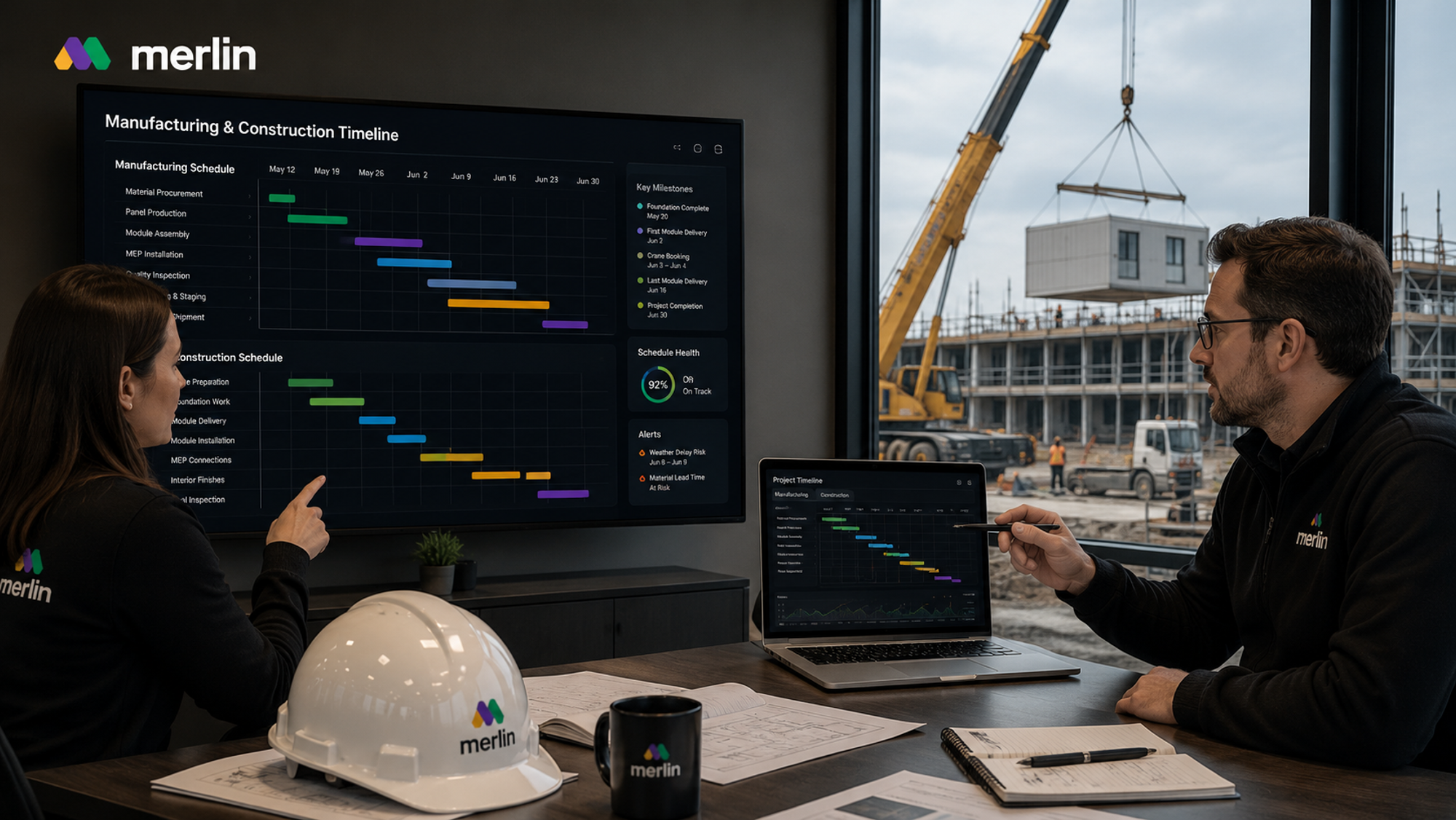
A modular home arrives on site two weeks early, but the foundation crew is not ready for it. A curtain wall panel run finishes on schedule, yet the crane needed to lift it into place is booked on another job for another ten days. These are not rare exceptions in offsite and hybrid construction. They are the default outcome when manufacturing schedules and construction timelines are managed as two separate worlds instead of one connected plan.
As more builders move framing, panels, MEP assemblies, and full modules into factory settings, the old assumption that construction runs on its own clock stops holding up. Production speed only creates value when the site is ready to receive what the factory ships. This post walks through why the two timelines drift apart, what true synchronization actually looks like, the practices that keep factory output and site sequencing aligned, and the tools modular builders now rely on to hold that alignment together.
Why Manufacturing and Construction Timelines Often Fall Out of Sync
Manufacturing scheduling and construction scheduling grew up as separate disciplines, and most teams still run them that way. A factory floor plans around machine capacity, shift patterns, and material lead times. A job site plans around weather, trade sequencing, permitting, and inspections. Each side optimizes for its own constraints without a shared view of the other.
Several patterns show up again and again:
Different planning horizons. Production teams often work in short, tight cycles measured in days. Site teams plan in weeks or months, with milestones tied to inspections and trade handoffs. When the two horizons do not overlap in the same system, small delays on either side compound before anyone notices.
Manual handoffs and disconnected spreadsheets. Many builders still pass schedule updates between factory and field through email threads or static spreadsheets. By the time a change reaches the other team, it may already be outdated.
Site readiness assumptions baked into the factory schedule. Production runs are frequently sequenced based on when a module or panel is supposed to be needed, not on verified site conditions. A permitting delay or an unfinished foundation on site does not automatically pause the factory line.
Limited visibility into logistics and transport windows. Even when production and construction are individually on track, the delivery and staging window between them is often the weakest link, especially for oversized modules that need specific road permits or crane availability.
The result is a familiar pattern: units sitting in a factory yard waiting on siteprep, or a crew standing idle waiting on a delayed shipment. Neither team caused the problem alone. It came from planning the work as two timelines instead of one.
What Does It Mean to Synchronize Manufacturing with Construction Timelines?
Synchronizing manufacturing schedules with construction timelines means both sides plan against the same sequence of dependencies, with changes on either end automatically reflected in the other. It is less about matching calendar dates and more about linking the actual dependencies that connect a factory task to a site task.
At a practical level, this involves a few core elements.
Shared dependency mapping. Every production milestone that a site activity depends on, and every site milestone that a production run depends on, is mapped explicitly. A wall panel production run is tied to the foundation inspection sign off that must happen before delivery. A site crew's crane booking is tied to the factory's confirmed ship date.
Real time status flow in both directions. When a production run slips because of a material shortage, the construction schedule reflects that immediately, and site teams can resequence other trades rather than standing idle. When a site delay pushes back the need date, the factory can adjust its run order instead of building inventory that has nowhere to go.
A common data layer. Rather than the factory using one scheduling tool and the site using another with no connection between them, synchronization usually means both teams are pulling from, or feeding into, a shared source of schedule data. This is where manufacturing resource planning software and construction scheduling platforms increasingly need to talk to each other, whether through integration or through a unified system built for both.
Buffer and lead time logic that reflects reality. Good synchronization builds in realistic buffers for transport, staging, and site readiness checks, rather than assuming a module can move from factory floor to installed position with zero friction.
The goal is not a single rigid master schedule that never changes. It is a live connection between two schedules so that a change in one is visible, and actionable, in the other.
Best Practices for Keeping Factory Output and Site Installation in Sync
Build the schedule backward from site readiness, not forward from production capacity. Many teams default to scheduling production first, then hoping the site catches up. A more reliable approach starts with confirmed site milestones such as foundation completion, utility connections, and inspection windows, then works backward to set production run dates that match. This keeps factory output tied to actual demand instead of theoretical capacity.
Use a single point of truth for schedule data. Whether that is an integrated platform or a set of connected tools, both the factory and the field need to be looking at the same numbers. Duplicate schedules maintained separately in different systems are one of the most common sources of drift.
Set explicit trigger points between production and site tasks. Rather than scheduling by date alone, tie key events to triggers. For example, a module ships only after a site readiness confirmation is logged, not simply because the calendar says it is ready. This prevents shipping ahead of a site that is not prepared to receive delivery.
Build in transport and staging as a scheduled phase, not a gap. Delivery windows, crane availability, road permits for oversized loads, and staging areas all deserve their own line items in the schedule, with realistic durations, rather than being treated as instantaneous.
Review both schedules together on a fixed cadence. A weekly joint review between production planning and site management, even a short one, catches drift early. This is far cheaper than discovering a mismatch when a truck is already en route.
Track variance, not just milestones. Recording how far actual production and actual site progress deviate from plan, over time, helps teams tighten their estimates for future projects rather than repeating the same buffer mistakes.
For teams building out their broader technology stack, our overview of construction resource planning tools covers how scheduling fits alongside budgeting, procurement, and field reporting.
What Tools Help Modular Builders Keep Production and Site Installation in Sync
Modular and offsite builders typically rely on a mix of the following categories of software, often integrated rather than used in isolation.
Production scheduling software. These tools manage factory floor sequencing, machine and labor capacity, and material availability. The stronger platforms in this category expose production status through APIs or dashboards that construction scheduling tools can consume, rather than keeping factory data siloed.
Construction scheduling and project scheduling software. Tools built for job site sequencing, trade coordination, and milestone tracking. When these platforms can ingest live production status, site teams gain visibility into whether an upcoming delivery is on track without needing a phone call to the factory.
Manufacturing resource planning software. Broader MRP systems handle material planning, inventory, and production capacity across multiple jobs at once. For modular builders running several projects through the same factory, MRP visibility is what prevents one job's rush order from silently delaying another job's run.
Unified manufacturing and construction platforms. A newer category of manufacturing software solutions is built specifically to bridge factory and field, combining production tracking, site scheduling, and logistics coordination in one system. For builders scaling offsite production across multiple sites, this reduces the integration work otherwise required to connect separate factory and field tools.
Logistics and delivery tracking tools. For oversized modules and panelized assemblies, dedicated tracking for permits, transport windows, and crane scheduling closes the gap between "shipped" and "installed."
The right combination depends on how much of the build happens offsite. A builder doing panelized components alongside traditional site work has different needs than a volumetric modular builder shipping finished units. See our guide to choosing construction technology for modular builders for a closer look at matching tools to build method.
Frequently Asked Questions
What is the main risk of not synchronizing manufacturing and construction schedules? The most common risk is idle time on either end, either finished units or panels sitting in a factory yard waiting on an unready site, or a site crew and equipment standing idle waiting on a delayed shipment. Both outcomes add cost without adding progress.
Can existing construction scheduling software integrate with factory production systems? Many modern construction scheduling and project scheduling software platforms support integrations or open APIs that can connect to production scheduling systems. The level of integration varies by vendor, so it is worth confirming API support and real time data sync before committing to a stack.
Is synchronization only relevant for fully modular or volumetric construction? No. Any project using offsite prefabrication, including panelized walls, prefabricated MEP racks, or precast components, benefits from aligning production timing with site readiness, even if the majority of the build happens on site.
How much lead time should be built in between production completion and site delivery? This varies by transport distance, permit requirements for oversized loads, and site storage capacity, but most experienced offsite builders build in buffer time specifically for staging and transport as a distinct schedule phase rather than assuming immediate delivery upon production completion.
What role does manufacturing resource planning software play if a builder only runs one factory? Even a single factory serving multiple projects benefits from MRP visibility, since material and capacity constraints on one job can quietly delay another. MRP software helps surface those conflicts before they affect a site schedule.