Why Construction Crews Lose Productive Hours and How Contractors Can Get Them Back
Discover how contractors can reduce crew downtime by connecting materials, labour, scheduling, and field operations to recover lost productive hours.
 Sneha Kumari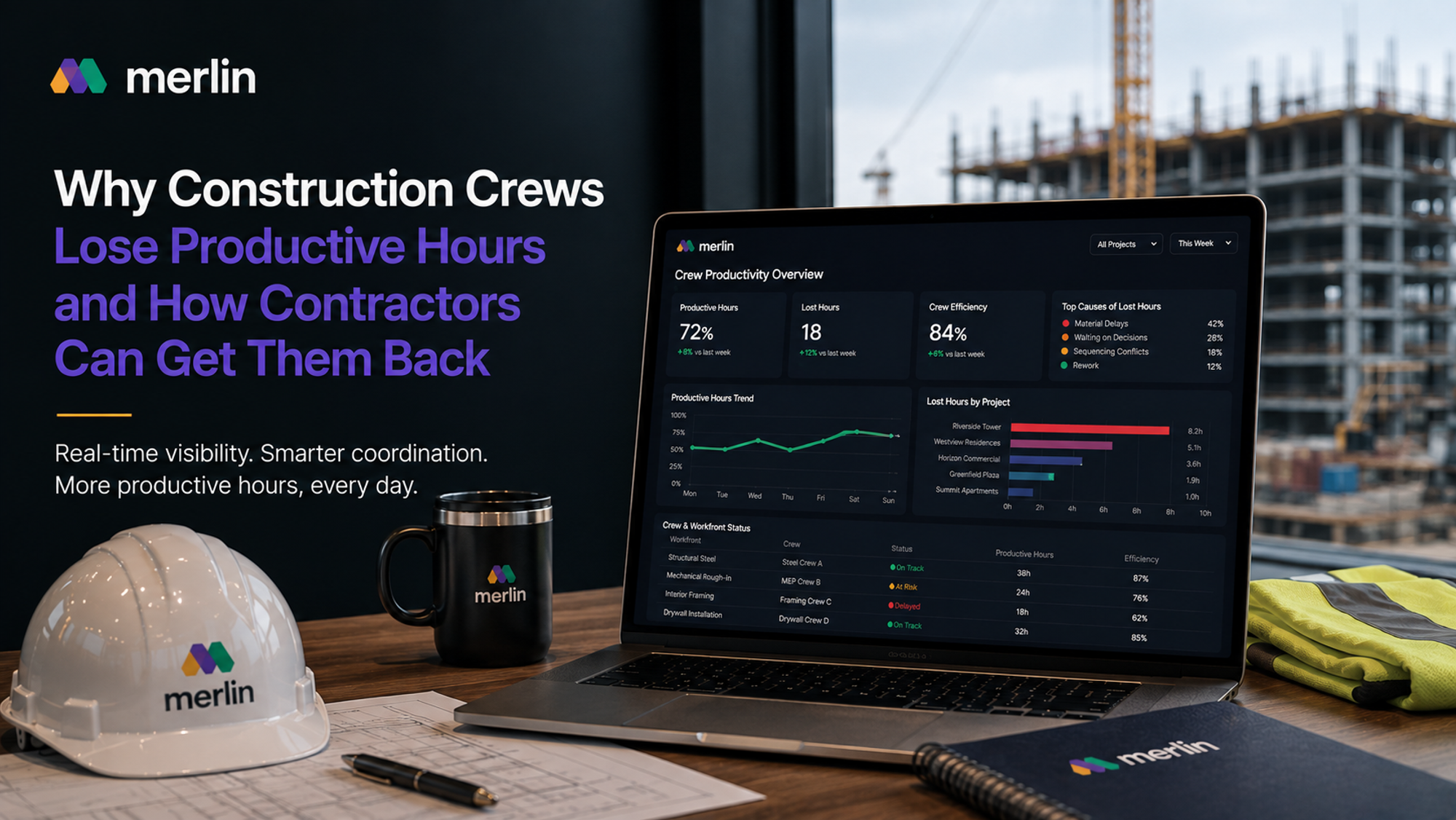
Construction crews lose more productive hours than any schedule ever admits to. Not to bad weather or to workers who are not trying, but to the quiet, recurring gaps between what is planned and what is actually available on site: a material delivery that has not arrived, a decision stuck in someone's inbox, two trades staged for the same space at the same time. None of it shows up as a line item on a Gantt chart, yet it is where construction crew productivity actually gets decided, hour by hour.
This article looks at where those hours go, why more monitoring rarely fixes the problem, and what it actually takes to recover them. It covers the shift from manual oversight to active orchestration, why aligning materials and labor in real time matters more than adding another dashboard, and how AI is starting to change what is possible for contractors managing complexity across multiple crews and sites. The goal throughout is practical: fewer lost hours, less firefighting, and construction labor productivity that holds up under real world conditions, not just on paper.
Where Productive Hours Disappear on a Construction Site
Every general contractor already knows the feeling: a crew shows up ready to work, and the first ninety minutes disappear before a single productive task begins. Materials have not arrived. The foreman is chasing down a change order approval. Two trades are staged for the same space at the same time. None of this shows up on a schedule as a line item, yet it is where construction crew productivity actually gets decided, hour by hour, day by day.
McKinsey has tracked this pattern at the industry level for years. Its research shows construction sector productivity has grown at a fraction of the rate seen across the broader economy and manufacturing over the past two decades, and the firm has estimated that closing this gap could unlock more than a trillion dollars in value across the global industry each year. That is not a story about lazy crews. It is a story about how much productive time gets absorbed by coordination failures that never make it into a report until the project is already behind.
At the crew level, construction crew downtime tends to concentrate around a small set of recurring causes:
- Material delays: crews standing idle because the right materials are not on site, not staged correctly, or buried behind other deliveries
- Sequencing conflicts: two crews or trades competing for the same physical space or equipment
- Rework: tasks completed against outdated drawings or specs that have to be redone
- Waiting on decisions: RFIs, change orders, or approvals that sit in someone's inbox while the crew waits
- Manual reporting: supervisors spending hours each week compiling status updates instead of managing the work in front of them
None of these are visible on a Gantt chart until they have already cost a day. That gap between what is planned and what is actually happening on site is where productive hours in construction quietly disappear, and it is also exactly where the opportunity to recover them lives.
Stop Policing and Start Producing to Keep Construction Crews Effective and Optimized
Most attempts to fix construction labor productivity start from the wrong assumption: that the problem is compliance. Add a time tracking app. Require photo check ins. Push crews to fill out more forms. The logic is understandable, more data should mean more control, but in practice it does the opposite. Foremen end up spending their most valuable hours proving what happened instead of directing what happens next.
Policing productivity treats the crew as the variable to manage. Producing treats the system around the crew, materials, sequencing, information, as the thing that needs managing. The difference matters because crews are rarely the actual bottleneck. A framing crew that stands idle for two hours is not underperforming; it is waiting on a system that failed to have materials staged, or a schedule that double booked a space, or a decision that never came through.
Shifting from policing to producing means:
- Giving supervisors visibility into what is coming next, not just a record of what already happened
- Surfacing conflicts and shortages before the crew reaches the point where they would cause downtime
- Reducing the administrative load on foremen so their time goes toward directing work, not documenting it
- Measuring construction productivity in terms of throughput and completed scope, not just hours logged
Contractors who make this shift tend to see the effect first in how their supervisors spend their day. Instead of reconstructing yesterday's problems from a stack of paper tickets or a dozen text threads, they start their morning already knowing what is at risk and can act on it before it becomes a lost hour. That single change, moving from reactive reporting to forward looking visibility, is often the biggest lever available for improving construction labor efficiency without adding headcount.
Reclaim Lost Hours by Moving from Manual Oversight to Active Orchestration
Manual oversight is what most construction operations run on today: a superintendent walking the site, a project manager reconciling spreadsheets at night, a series of phone calls to figure out where a material delivery actually is. It works, but it works reactively. By the time a problem is visible to the person who could fix it, the crew has often already lost the hour.
Active orchestration is a different model. Instead of a person manually pulling together status from five disconnected sources, the operational system itself continuously tracks material position, crew assignment, sequencing dependencies, and cost, and it surfaces conflicts before they cost time. This is the same underlying shift behind why so many construction projects run behind schedule, and what it actually takes to break that pattern.
The practical shift looks like this:
- From end of day reporting to continuous visibility into what is happening on site right now
- From a superintendent memorizing ten open issues to a system that flags them automatically, in priority order
- From reactive firefighting to proactive resequencing when a delay is detected early enough to route around it
- From siloed updates in text messages and paper tickets to one place where materials, labor, and schedule status all live together
This is especially visible for contractors running self perform crews, where the general contractor owns both the labor and the coordination risk directly. When a self performing crew sits idle, there is no subcontractor to absorb the cost; it lands squarely on the GC's own labor budget. Active orchestration gives that GC the same forward visibility a production manager would expect on a factory floor, applied to a jobsite instead.
How Operational Intelligence Keeps Materials and Labour Aligned to Eliminate Downtime
A huge share of construction crew downtime traces back to a single root cause: materials and labor being planned as two separate problems instead of one connected system. The schedule says a crew starts framing on Tuesday. Procurement, working from a different document, has the lumber arriving Thursday. Nobody catches the mismatch until Tuesday morning, when the crew is standing on site with nothing to build.
Operational intelligence closes that gap by keeping materials, labor, and cost as one continuously updated picture rather than three reports that get reconciled after the fact. When a delivery slips, the system flags every downstream task and crew assignment that depends on it, immediately, not at the next weekly meeting. This is the same principle behind treating materials, labour, and cost as one connected system rather than reconciling them after the fact.
The effect on crew productivity is direct:
- Crews are never scheduled onto a task that lacks the materials to complete it
- Shortages surface days in advance, giving procurement time to expedite or resequence rather than scrambling on the morning of
- Labor assignments update automatically when a task shifts, instead of a supervisor manually reworking the plan
- Cost impact of a delay is visible immediately, not discovered weeks later during a reconciliation
For contractors running material heavy operations out of a yard or staging facility, this alignment is often the difference between a smooth handoff to the crew and a morning lost to searching for missing product. Getting inventory management under warehouse control rather than ad hoc jobsite ordering is frequently the first structural fix that reduces construction downtime at scale, because it removes the single most common reason a crew stands idle.
Recover Productive Time with a Real Time Execution Layer for Construction
Most construction software reports on what already happened. Daily logs, weekly reports, and dashboards updated after the fact are useful for accountability, but they cannot recover an hour that has already been lost. Recovering productive hours in construction requires a different kind of system: one that operates in real time, while the work is happening, not after.
A real time execution layer sits underneath the schedule and the budget and continuously reconciles what is actually happening on site against what was planned. When a crew finishes a task early, the system already knows what comes next and where that crew should move. When a delivery is delayed, the affected tasks and crews are flagged the moment the delay is known, not the next time someone opens the schedule. When two trades are about to collide over the same space, the conflict surfaces before either crew shows up, not after they have both lost the morning arguing about it.
This shift changes what "managing productivity" actually means day to day:
- Supervisors spend their morning acting on flagged risks instead of hunting for them
- Crew moves between tasks are planned in advance instead of improvised on site
- Project leadership sees construction productivity trends as they happen, not two weeks later in a report
- Downtime gets caught and rerouted while there is still schedule float to absorb it, rather than discovered after it has already pushed the completion date
The value is compounding. Contractors managing multiple active projects, or working alongside developers who need visibility across every site without constant site visits, find that a real time layer scales far better than adding more supervisors to catch the same problems manually.
How to Use AI to Manage Project Complexity and Make Crew Execution Inevitable and Reduce Downtime
Construction projects have gotten more complex, more trades, more compressed schedules, more moving parts across more sites, without a corresponding increase in the tools available to manage that complexity. AI changes the equation, not by replacing the superintendent's judgment, but by handling the volume of coordination that no person could track manually across dozens of active tasks and crews.
Applied well, AI does three things that directly protect productive hours:
- Pattern recognition: identifying which combinations of trade, sequence, and site have historically produced delays, and flagging similar setups before they repeat
- Continuous reconciliation: cross referencing materials, labor, and schedule in real time so a mismatch is caught the moment it happens, not at the next status meeting
- Prioritized surfacing: instead of a wall of data, giving supervisors a short, ranked list of what actually needs attention today
The goal is not more dashboards. It is fewer decisions that a person has to make manually before a crew can move. When the system already knows a crew is about to run out of material, has already flagged the next available task, and has already notified the affected trade, execution stops depending on someone remembering to check. That is what makes crew execution inevitable rather than something that has to be manually forced into place every morning. Contractors delivering the same building type repeatedly get an additional benefit here: patterns from earlier phases feed directly into repeatable delivery across every future building, so each project gets faster to plan and less prone to the downtime that caught the last one by surprise.
Contractors evaluating where to start typically get the fastest return by applying this to the highest volume decision points first: material staging, crew sequencing, and daily task assignment, the three areas where a five minute delay multiplied across a crew and a week adds up to the productivity loss that shows up at the end of the month.
Frequently Asked Questions
What is construction crew downtime, and how is it different from a delayed project?
Construction crew downtime refers to the hours a crew spends unable to do productive work: waiting on materials, waiting on a decision, or standing idle because of a sequencing conflict. A project can still finish on the original completion date even with significant downtime baked into it, because schedule float absorbs the loss. The downtime shows up as lower construction crew productivity and higher labor cost per unit of work, even when the overall project timeline looks unaffected on paper.
How much does lost productive time actually cost a contractor?
The cost compounds in a way that is easy to underestimate. A crew standing idle for an hour is not just that hour's wages; it is the ripple effect on every task scheduled after it, plus the overtime often needed to recover the lost ground. Industry research, including work published by McKinsey, has pointed to construction labor productivity growing at a fraction of the rate seen in the broader economy for decades, a gap that reflects billions of dollars in avoidable cost across the sector each year.
What is the fastest way for a contractor to start improving construction labor efficiency?
Start with visibility before adding process. Most contractors already know their crews lose time to material delays and sequencing conflicts, what they lack is a way to see those risks coming before they cost an hour. Getting materials, labor, and schedule status into one continuously updated system, rather than reconciling them in separate reports, is typically the highest leverage first step toward reducing construction downtime.
Does improving construction crew productivity mean adding more oversight or monitoring?
Not in the way most contractors assume. Heavier monitoring, more forms, more check ins, tends to shift a supervisor's time toward documentation instead of directing the work. The more effective approach focuses on giving supervisors forward visibility into what is coming next, so they can resolve conflicts before the crew reaches them, rather than adding tools that only record what already went wrong.
Can AI actually reduce construction downtime, or is it mostly reporting after the fact?
The distinction matters. Traditional software reports on what already happened, which is useful for accountability but cannot recover a lost hour. AI applied to construction operations works differently when it operates in real time: continuously reconciling materials, labor, and schedule so a shortage or conflict is flagged the moment it appears, giving supervisors the chance to reroute the crew before downtime occurs rather than explaining it afterward.