Construction Project Delivery Risk: What Developers Need to Monitor
Learn how developers can identify early warning signs, track delivery risks, and use project data to prevent delays, cost overruns, and missed milestones.
 Sneha Kumari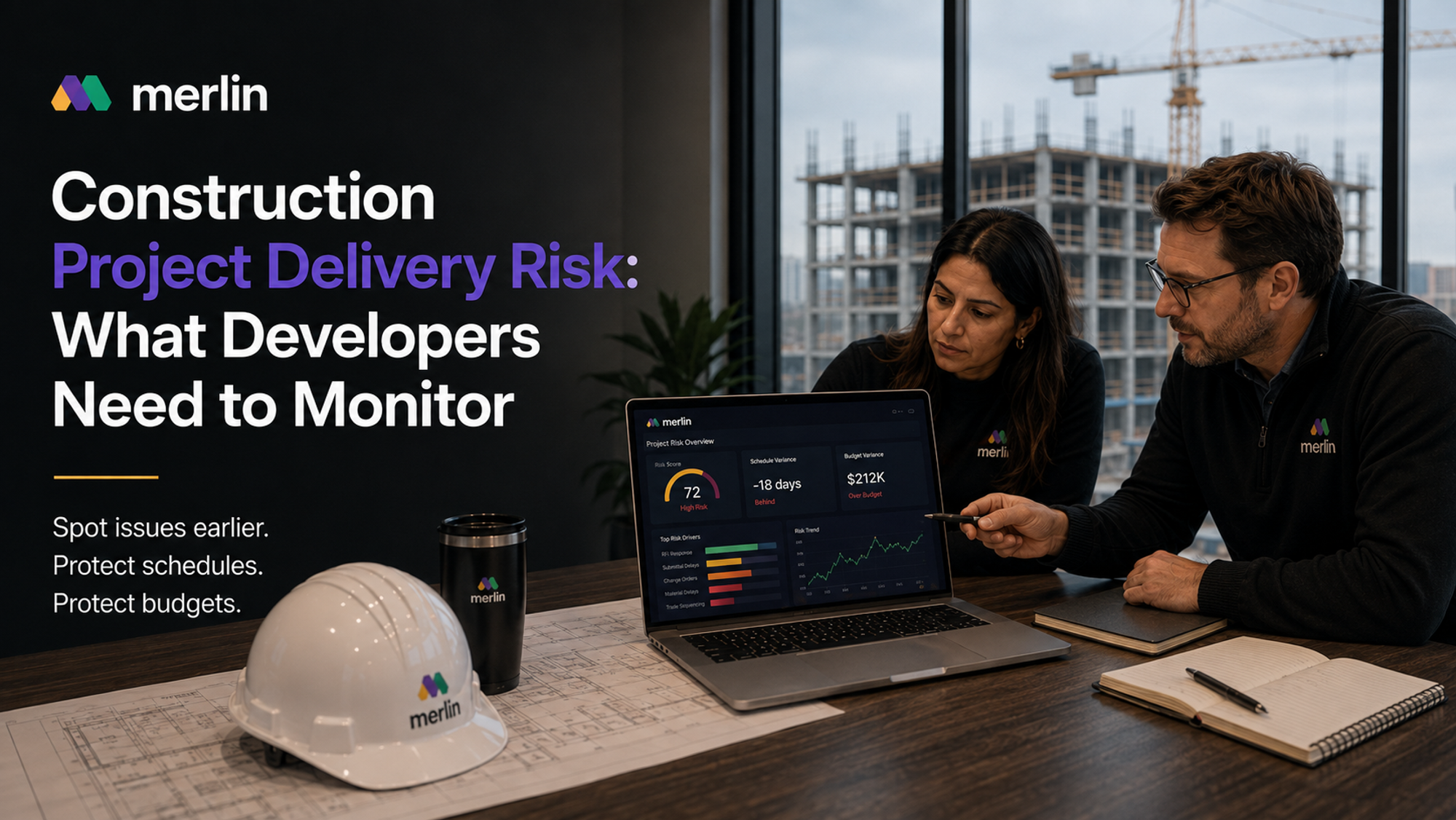
A general contractor's monthly report says the project is on track. Three weeks later, the same project is six weeks behind schedule and two hundred thousand dollars over budget, and nobody can point to the exact moment it went wrong. This gap, between what a status update says and what is actually happening on site, is where most construction project delivery risk hides.
For developers running one project or a dozen, the problem is rarely a lack of information. It's that the information arriving through periodic updates is summarized, after the fact, and built to explain what already happened rather than flag what is still developing. By the time a delay or cost overrun is visible in a report, the underlying cause has usually been building for weeks. Below is where delivery risk actually starts, the early signals that precede a missed milestone, what a construction project management platform should track to catch it sooner, and how developers can build a process that stays ahead of risk instead of reacting to it.
Where Construction Delivery Risk Actually Starts and Why It Often Goes Unnoticed
Most delivery risk does not begin on the job site. It begins upstream, in the handoffs between design, procurement, and construction, long before a delay or cost overrun becomes visible in a monthly report. A design change that is not communicated clearly to every trade. A supplier commitment that was never formally confirmed. A subcontractor sequencing conflict that nobody flagged because two crews were not talking to each other directly.
For developers, the problem is not that these things happen. It's that construction project delivery risk usually accumulates quietly for weeks before it shows up as a missed milestone. By the time a general contractor's status update mentions a delay, the underlying cause, whether it's a coordination gap between trades or a subcontractor sequencing issue, has usually been building for some time.
This is why construction risk management that starts at the monthly report stage is already too late. Real risk tracking has to start where the risk actually originates: in the handoffs, the commitments, and the day to day coordination between everyone touching the project, not just in the summary document that reaches the developer's desk once a month.
The Early Warning Signs Behind Delays, Cost Overruns, and Missed Milestones
Long before a schedule slips or a budget line goes red, a handful of leading indicators tend to move first. Developers who know what to watch for can catch problems while there is still time to act.
- RFI response time - requests for information that sit unanswered longer than usual often signal a design or coordination bottleneck upstream.
- Submittal turnaround - slow approvals on submittals frequently precede material and procurement delays by weeks.
- Change order velocity - a rising rate of change orders, even small ones, is one of the clearest signs that scope or specs were not locked down cleanly.
- Subcontractor responsiveness - trades that go quiet between scheduled milestones are more likely to be behind than trades reporting regularly, even with bad news.
- Budget variance trend - a budget that is technically on track but trending the wrong direction month over month is a much stronger signal than a single variance snapshot.
None of these signals are dramatic on their own. The risk is in how they compound. A slow RFI response combined with a rising change order rate is a very different situation than either signal alone, and cost tracking that only looks at totals, not trends, will miss the pattern until it is already a problem.
What Developers Need to Know When Project Updates Don't Tell the Full Story
Most developers manage project delivery risk through periodic updates from a general contractor or construction manager, whether that's a weekly call, a monthly report, or a dashboard populated by someone else's team. These updates are useful, but they are also, by nature, summarized and after the fact.
A status marked "on track" can be accurate at the moment it's written and still miss a problem that is actively developing underneath it. Reports tend to reflect what has already been resolved or what is easy to explain in a paragraph, not the slow accumulation of small delays or the informal workaround a site team used to avoid flagging an issue that week.
This is not usually about anyone withholding information. It's a structural limitation of narrative reporting. Developers who want a fuller picture need visibility into the underlying data, not just the summary built from it, and need consultants and trades genuinely aligned on what "on track" actually means for their specific project, rather than relying on a general contractor's judgment call alone.
Construction Platforms for Developers Managing Project Delivery Risk: What Should They Track?
A construction project management platform built for delivery risk should give developers direct access to the data behind the status update, not just the update itself. At minimum, that means tracking:
- Schedule variance by milestone - not just whether the project is behind, but which specific milestones are slipping and by how much.
- Budget variance by cost code - granular enough to show where money is actually moving, not just an aggregate number.
- Procurement and supplier status - which materials and equipment are on track, at risk, or already late, tied to the schedule dates they affect.
- Change order trends - volume, cost, and cause, tracked over time rather than reviewed order by order.
- Open RFIs and submittals - aged by how long they've been outstanding, not just a current count.
The platform matters because these data points live in different systems by default, procurement in one place, scheduling in another, financials somewhere else. Construction platforms for developers that unify this data, rather than requiring someone to manually reconcile it, are what actually make construction project risk management practical across more than one active project at a time.
Turning Scattered Project Signals Into Actionable Delivery Risk Insights
Having access to the right data is only half the problem. The other half is turning scattered signals, a submittal delay here, a budget variance there, a subcontractor going quiet on a different project, into something a developer can actually act on.
This is where risk tracking becomes a portfolio level function rather than a single project exercise. A developer managing several active projects needs to see which ones are trending toward risk before any single metric crosses a hard threshold, and needs to compare that trend against similar projects rather than judging each one in isolation. Tracking progress across every active project in one consistent view is what makes this comparison possible, instead of reconstructing it from separate reports each time.
This is particularly true for developers running repeatable building programmes, where the same risk pattern showing up on project three is a much stronger signal than it would be on a one off build.
The goal is not more data. It's fewer, clearer signals: a short list of projects and metrics that genuinely need attention this week, filtered out of everything that is still within normal range. Developers who get this right spend their attention on the two or three projects actually drifting off track, instead of reading the same length report for every project regardless of how it's performing.
How Developers Can Stay Ahead of Risks Before They Impact Project Completion
Staying ahead of delivery risk is less about predicting the future and more about shortening the distance between a problem starting and a developer finding out about it.
A few practices make the biggest difference. Standardizing how every general contractor and consultant reports status, using the same categories, the same cadence, and the same level of detail, makes it possible to compare projects honestly instead of comparing however each team happens to write its updates. Standardized specifications at the front end reduce a major source of change order risk before it ever reaches a status report. Setting explicit thresholds for schedule and budget variance, rather than relying on subjective judgment calls about what counts as "a little behind," gives everyone a shared definition of when something needs escalation.
None of this removes risk from construction projects. Delivery risk is inherent to the work. What changes is how early a developer sees it and how much room is left to respond when they do. Teams that treat delivery risk monitoring as a continuous, structured process, not a monthly check in, are the ones who catch problems while a schedule adjustment or a supplier substitution is still a manageable fix rather than an expensive one.
Frequently Asked Questions
What is construction project delivery risk?
Construction project delivery risk is the likelihood that a project will not be completed on time, on budget, or to the agreed scope, driven by factors like coordination gaps, procurement delays, change orders, and subcontractor performance. It builds gradually and is often visible in leading indicators before it appears in a status report.
How does construction risk management differ from typical status reporting?
Typical status reporting summarizes what has already happened, often after issues have been resolved or explained. Construction risk management focuses on leading indicators, like RFI response times, change order velocity, and budget trend, that surface problems while there is still time to respond, not after the fact.
What should developers track for construction risk tracking across multiple projects?
Developers should track schedule variance by milestone, budget variance by cost code, procurement and supplier status, change order trends, and aged RFIs and submittals. Tracking these consistently across every active project makes it possible to compare portfolio wide risk rather than judging each project in isolation.
Why do project updates sometimes miss developing risks?
Status updates are summaries built after the fact, and they tend to reflect what has already been resolved rather than problems still developing underneath. A project can be accurately reported as "on track" and still be accumulating risk that has not yet crossed a reporting threshold.
How can a construction project management platform reduce delivery risk?
A construction project management platform reduces delivery risk by unifying schedule, budget, procurement, and change order data in one place, so developers see the underlying signals directly instead of waiting for a narrative summary. This shortens the time between a problem starting and a developer finding out about it.