How Mechanical Contractors Are Building Prefab Shops in 2026
How mechanical contractors are building prefab shops in 2026 the operational systems, common mistakes, and what it takes to make prefab a real margin advantage.
 Sneha Kumari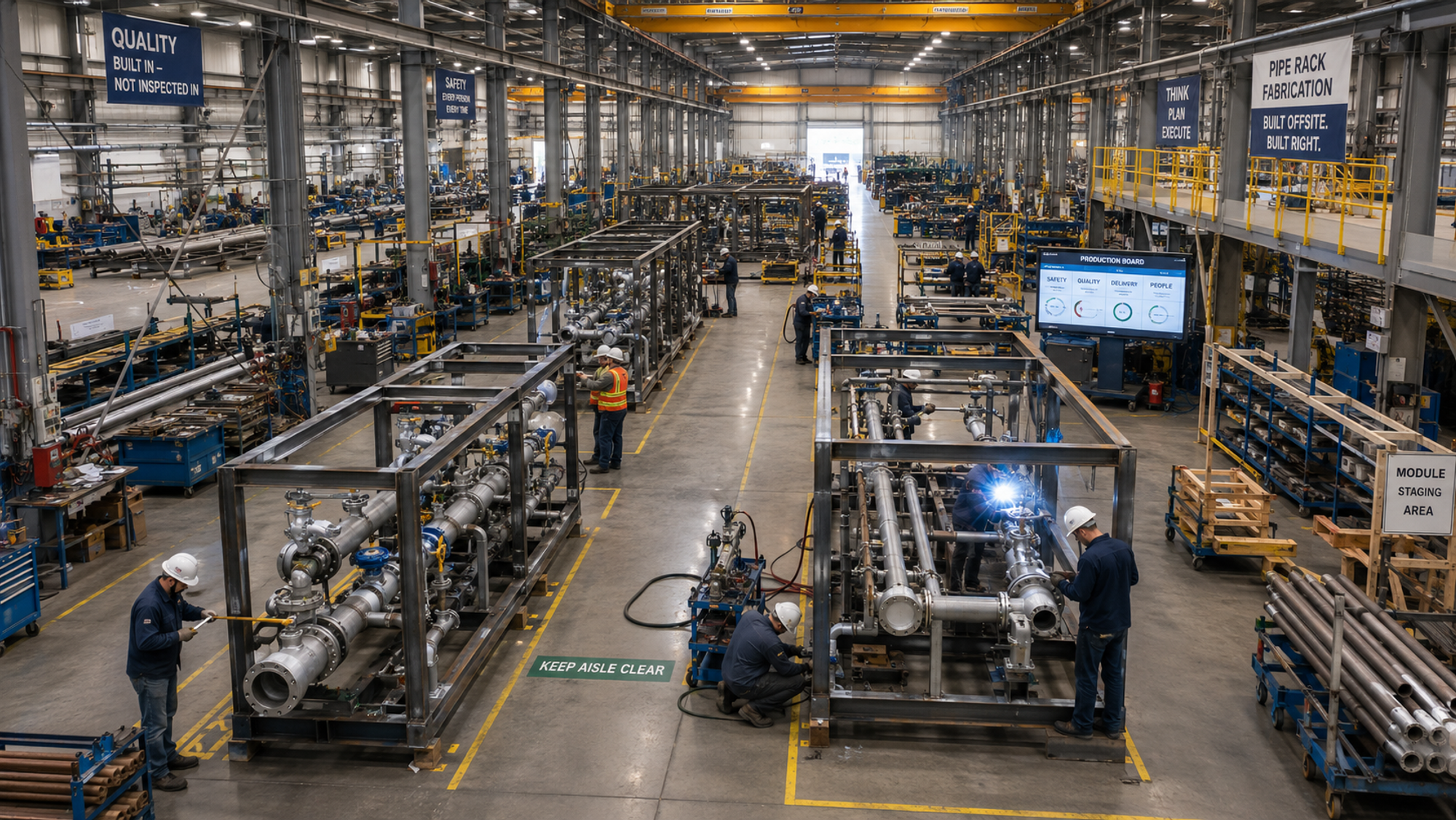
Something is changing on construction sites across North America. Fewer racks are being built in the ceiling. Fewer conduits are being bent on a ladder. More and more of that work is happening somewhere else in a shop, at a warehouse, on a production line that looks less like a jobsite and more like a factory.
Mechanical contractors are leading this shift. And the ones who have made it work are not talking about it as a trend. They are talking about it as the single best decision they ever made for their margins, their schedule performance, and their ability to grow without adding proportional headcount.
This post breaks down exactly how that shift is happening what it looks like operationally, what problems it solves, and what it takes to run a prefab division that actually performs.
Why Mechanical Contractors Are Moving Work Off-Site
The case for prefabrication is not complicated. When you build racks, assemblies, or systems in a controlled environment, you eliminate most of the variables that kill productivity on a jobsite other trades in the way, incorrect information, weather, material delays, and the simple physical difficulty of working overhead in a half-finished space.
Labour is the biggest lever. A technician building a rack assembly in a shop environment, with all materials staged and a clear production sequence, can produce significantly more work in a day than the same technician threading pipe in a ceiling with a wrench and a headlamp. The numbers vary by work type and company, but efficiency gains of 30 to 50 percent in labour hours are routinely reported by contractors who have made the transition.
But labour productivity is just the beginning. Prefab also compresses schedule — work that was on the critical path is now being produced in parallel. It reduces rework because assemblies are built from accurate information in a controlled environment. And it increases quality consistency in ways that matter for repeat customers and long term relationships.
What a Prefab Shop Actually Looks Like
The concept of a prefab shop sounds capital intensive. In practice, most mechanical contractors start much smaller than they expect. A 5,000 to 10,000 square foot space, a rack of pipe, a threading machine, a saw, some assembly tables, and the willingness to think differently about how work gets sequenced.
The physical layout matters less than the operational logic. A prefab shop is a production environment. That means work moves through stages: incoming material, cutting and threading, assembly, quality check, staging for delivery. Each stage needs clear definitions of what goes in and what comes out. That is fundamentally different from a jobsite, where work happens in whatever order the conditions allow.
The companies that struggle with prefab almost always have the physical infrastructure right but the operational systems wrong. They are running a production environment on a mental model built for project work. Work orders are verbal. Inventory is approximate. Scheduling is reactive. And the shop ends up as chaotic as the jobsite it was supposed to simplify.
The Four Operational Problems Every New Prefab Shop Faces
- Inventory visibility — materials arrive without a clear home, get consumed without being tracked, and shortages only surface when an assembly is half-built and someone goes looking for a fitting that isn't there.
- Work order management — without a formal system, production priorities are set informally, work gets started without all the materials in place, and the shop floor operates on whoever shouts loudest.
- Delivery coordination — assemblies need to arrive on site at the right time, in the right sequence, labelled so installation crews know exactly what goes where. Without coordination, the shop produces work that creates confusion rather than clarity.
- Cost tracking — prefab is supposed to improve margins. But without tracking labour hours and material consumption at the work order level, you cannot prove it is working or identify where it is not.
How Successful Prefab Shops Run Their Operations
The mechanical contractors who have built prefab divisions that actually compound that get more efficient every quarter rather than hitting a wall share a common operational approach.
They start with structured work orders. Every assembly that enters production has a work order that defines the materials needed, the sequence of operations, the time allocated, and the delivery date. Nothing goes into production without one. This single habit eliminates most of the chaos that kills early prefab efforts.
They manage inventory as inventory not as 'materials on the floor'. That means receiving into a system, tracking consumption against work orders, and generating purchase orders from actual demand rather than guesswork. The difference between running inventory as a supply chain function and running it as 'stuff that arrived on a truck' is the difference between a shop that scales and one that stagnates.
They treat delivery as part of the production process. Tagging, sequencing, documentation, and communication with site teams all happen as part of the production workflow, not as an afterthought. When an assembly arrives on site, the installation crew knows what it is, where it goes, and in what order.
What Changes When You Have the Right System
The contractors who have invested in a proper operational system for their prefab division not a spreadsheet, not a whiteboard, and not a construction project management tool repurposed for shop work consistently report the same outcomes.
Throughput increases because production is planned rather than reactive. Costs reduce because material consumption is tracked and waste is visible. Margin improves because labour productivity can be measured and improved systematically. And growth becomes possible without proportional headcount increases, because the system carries the coordination burden that would otherwise require another supervisor.
Merlin EOS is built for exactly this environment. It runs the production operations of contractors who have moved work off-site inventory, work orders, assemblies, scheduling, cost tracking, and delivery coordination in a single system designed for the way a shop actually works. Not adapted from a project management tool. Built for production from the ground up.
If you are a mechanical contractor considering a prefab division, or already running one on spreadsheets, the operational foundation you build now will determine whether prefab becomes a genuine competitive advantage or just another management headache.
Many contractors who build prefab shops take the next logical step and open a dedicated warehouse to receive materials, hold finished assemblies, and stage deliveries in project sequence. If you are considering that move, our guide on why contractors are opening warehouses and how to run them covers exactly what that operation requires from day one.
Inventory visibility is the most common early failure point in new prefab shops. Moving from site-based materials ordering to integrated inventory management — where materials are received, tracked, and allocated to specific work orders — is the single operational change that most directly determines whether a prefab shop scales or stagnates.
The same operational shift driving prefab adoption is also reshaping how GCs approach their own workforce. An increasing number of general contractors are building self-perform divisions — bringing framing, concrete, and interior work in-house rather than subcontracting it — and the production systems that run a prefab shop and a self-perform division share more in common than most people expect.
Merlin is the operational intelligence and execution orchestration platform built for the construction industry — continuously aligning materials, labour, cost, and decisions in real time across every active project. The platform serves three participants in the construction ecosystem: contractors industrialising through prefab, self-perform, and warehouse operations; developers who need their supply chain to coordinate like a production system; and suppliers looking for a direct route into live construction projects. Merlin EOS runs production operations, Merlin PI coordinates projects, and Merlin Merchant connects suppliers to work. Unlike tools that report on work after the fact, Merlin orchestrates it while it is happening. When Merlin runs production, execution becomes inevitable.
Frequently Asked Questions
Q: How much space do I need to start a prefab shop?
A: Most mechanical contractors start with 5,000 to 10,000 square feet. Physical space is less important than operational setup. A well-run small shop outperforms a disorganised large one every time. Start with the minimum viable space and the right operational systems you can always expand the footprint.
Q: Can I run a prefab shop on a spreadsheet?
A: Many contractors start on spreadsheets, but it creates a ceiling quickly. Once you have more than two or three active work orders running simultaneously, the manual tracking burden becomes unsustainable and errors start compounding. A system built for production operations is not a luxury it is what separates shops that scale from ones that stagnate.
Q: How long does it take for a prefab division to become profitable?
A: Most contractors see measurable labour productivity gains within the first three to six months. Full profitability depends on setup costs, volume, and how quickly the operational systems are established. Shops that start with clear work order processes and proper inventory management reach profitability significantly faster than those that improvise.
Q: Does prefab work for small mechanical contractors?
A: Yes. The efficiency gains from prefab apply at almost any scale. Contractors with 30 to 50 employees running a focused prefab shop on the right work types rack assemblies, pipe spools, equipment skids can see material improvements in margin and schedule performance. You do not need to be a large company to make prefab work.