Which Construction Projects Need Your Attention First? A Framework for Owner Teams
A framework for owner teams to rank live projects by urgency, using five signals (schedule variance, budget drift, RFI aging, procurement risk, and subcontractor performance) instead of waiting on weekly status reports.
 Sneha Kumari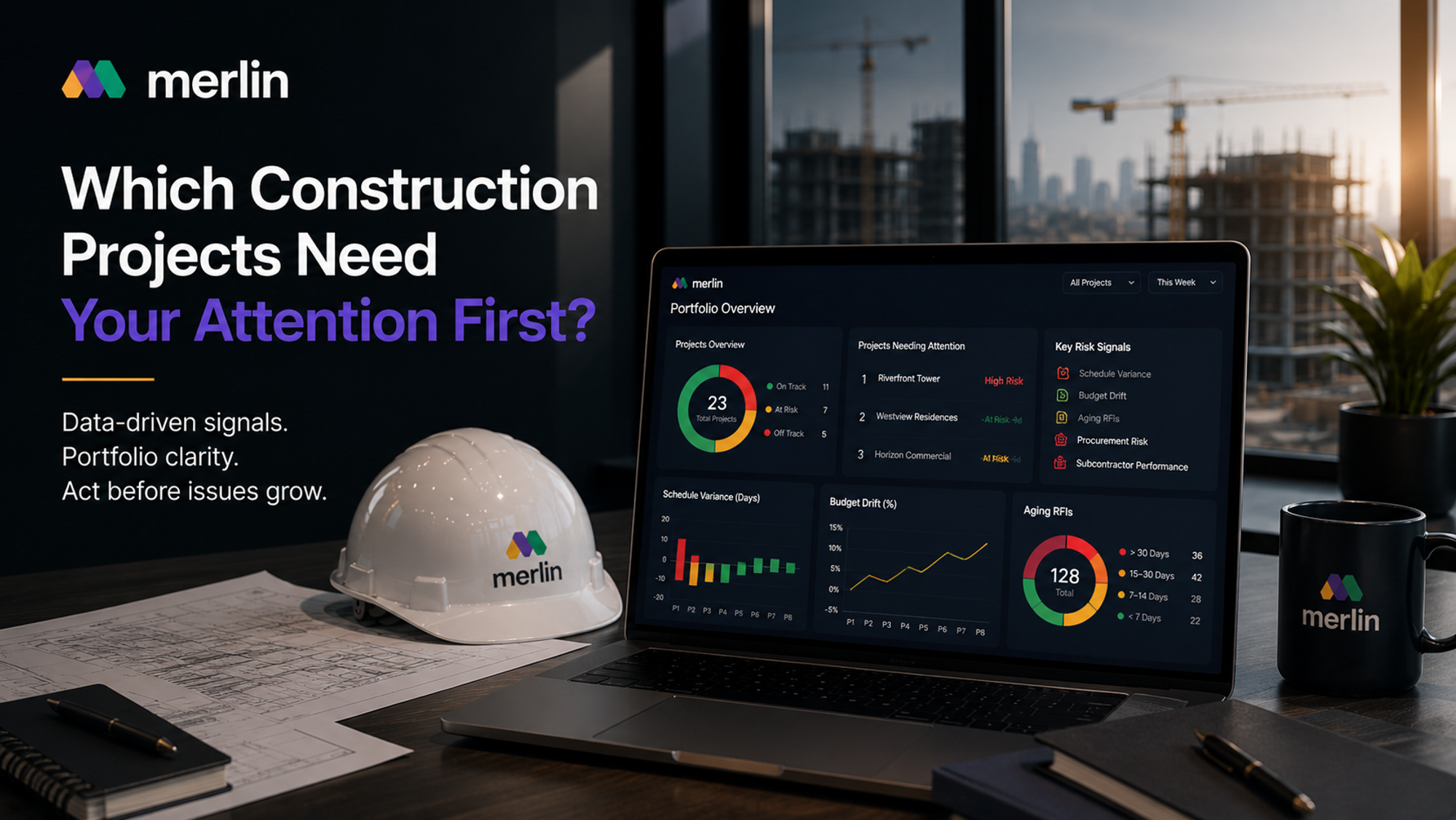
Construction owner teams managing fifteen active projects cannot give every one of them equal attention every week, and trying to is exactly what keeps the wrong problems invisible until they are expensive. The traditional answer, a status report and a red amber green tracker, tells you where a project stood last week. It does not tell you which project, out of the whole portfolio, actually needs a decision today.
This is a framework for closing that gap. It starts with why reactive monitoring traps owner teams into reviewing history instead of acting on it, then breaks down the five signals (schedule variance, budget drift, RFI aging, procurement risk, and subcontractor performance) that construction operational intelligence uses to rank projects by urgency rather than by however loudly they escalate. From there, it covers what changes when owner teams move from policing contractors after the fact to producing alongside them in real time, how agentic AI reconciles that complexity continuously across an entire portfolio, and a concrete, repeatable process for turning all of it into a weekly triage an owner team can actually run. The result is not another dashboard. It is a clear answer, every week, to the question every owner team is really asking: which construction projects need your attention first.
Beyond the Oversight Trap: Shifting from Reactive Monitoring to Active Project Orchestration
Most owner teams run their portfolio the same way: a weekly call, a status spreadsheet, a red amber green tracker that someone updates on Friday afternoon. It feels like oversight. In practice, it is closer to archaeology. By the time a status report shows a project turning amber, the underlying problem has usually been building for two or three weeks.
This is the oversight trap. It is not a failure of effort. Owner teams checking in on ten, twenty, or fifty active projects are doing exactly what the traditional model asks of them: reviewing what has already happened and reacting to it. The trap is structural. A status report is a snapshot, not a signal. It tells you where a project was last week, not where it is heading next week.
Reactive monitoring also forces owner teams into a triage pattern that rewards the loudest project rather than the most urgent one. A subcontractor who escalates loudly gets attention. A project quietly drifting off its critical path because of an unanswered RFI does not, at least not until the drift shows up in a monthly report. Unanswered technical questions are one of the most common causes of construction project delays, and they rarely announce themselves before they compound.
Active project orchestration works differently. Instead of asking teams to report status, it asks the underlying data (schedule, procurement, budget, work orders) to surface the projects that need a decision now. The owner team's job shifts from collecting updates to acting on prioritized signals: you cannot prioritize what you cannot see continuously, and you cannot see continuously with a reporting cadence built for a slower industry.
How Operational Intelligence Identifies Which Projects Need You Now
Construction operational intelligence works by continuously reconciling the data every active project already generates: schedule updates, procurement status, budget commitments, work order progress, and RFI logs. Instead of waiting for a person to compile that data into a report, the system watches for deviation in real time and ranks projects by how urgent that deviation is.
For owner teams managing a portfolio, that ranking comes down to five signal categories. Each one, on its own, is a normal part of running a project. Together, and tracked continuously, they tell you which project needs a decision this week and which can run another cycle without one.
Schedule variance against the critical path
A single late task rarely matters. A late task on the critical path always does. Construction project monitoring should distinguish between the two automatically, because a manual status report usually shows percent complete, not which incomplete items are actually blocking downstream work.
Budget and cost drift
Committed cost creeping ahead of physical progress is one of the earliest, most reliable indicators that a project is heading for trouble. Change order volume and forecast to complete matter more than the headline budget variance number, because they show whether the drift is accelerating.
Aging RFIs and unanswered technical blockers
An RFI open for three days is routine. An RFI open for three weeks is a stalled trade and a schedule slip that has not shown up anywhere yet. Tracking the age of open items, not just the count, is what turns this into a genuine prioritization signal.
Procurement and material delivery risk
Long lead items slipping their delivery window rarely cause immediate disruption. They cause disruption weeks later, when the site is ready for material that has not arrived. Construction project visibility that includes supplier commitments catches this early enough to act.
Work order and subcontractor performance deviation
When a trade reports thirty percent complete on a work order that should be sixty percent complete, that gap is often the earliest visible signal of a coordination problem. On multi site programs, this is also where performance patterns across a preferred subcontractor panel become visible, rather than isolated to a single site.
A sixth signal deserves a category of its own: silence. A project that has not updated its work orders, has not logged progress, or has gone quiet on RFIs is not a project that is running smoothly. It is a project the owner team has lost visibility into, which is its own form of risk. Any construction project prioritization framework needs to treat data silence as a flag, not an absence of flags.
Weighted and tracked together, these five signals (plus the silence check) produce something closer to a triage list than a status report: the two or three projects, out of a portfolio of many, that actually need an owner decision this week.
From Policing to Producing: Why Owner Teams Need a Real Time Execution Layer
There is a subtle but important difference between an owner team that polices a project and one that produces alongside it. Policing means checking whether the contractor did what they said they would do, usually after the fact and in a meeting built around accountability rather than problem solving. Producing means the owner team has the same real time picture of the project as the people running it, so decisions get made while they can still change the outcome rather than when they only explain it.
Most owner teams default to policing not because they prefer it, but because it is the only mode a lagging reporting cadence supports. If the data you receive is a week or a month old, the only useful question left is who is accountable for what already happened. That question has its place, but it does not prevent the next delay.
A real time execution layer changes what is possible. When schedule, procurement, budget, and work order data update continuously rather than on a reporting cycle, the owner team can ask a forward looking question instead: what needs to happen in the next five working days to keep this project on track. That is a fundamentally different conversation with a contractor or subcontractor, and it tends to produce a fundamentally different relationship. Developers who move from a policing posture to an active coordination role consistently see fewer disputes at practical completion, largely because problems surface while there is still time to solve them without a claim.
This is also where construction project management stops being a function performed by a single project manager and becomes a shared operational layer across the owner's whole portfolio. A real time execution layer does not just serve one project. It lets an owner team compare five, ten, or fifty projects on the same basis, using the same signals, so the projects that need attention rise to the top regardless of which project manager happens to be the most vocal in a status meeting.
Using Agentic AI to Reconcile Construction Complexity in Real Time
Reconciling five signal categories across dozens of live projects is not a task a person can do manually at the frequency it actually requires. A weekly review catches problems a week late, and a daily manual review is not a realistic ask of any owner team, no matter how disciplined. This is the specific problem agentic AI is suited to solve: not replacing the judgment of the owner team, but continuously doing the reconciliation work that judgment depends on.
An agentic system does not simply display a dashboard. It actively monitors schedule, procurement, budget, and work order data as it changes, flags the deviations that matter, and surfaces them ranked by urgency rather than by however a report happens to be organized. When a subcontractor logs 30 percent progress against a work order that should be 60 percent complete, the system does not wait for a monthly rollup to notice. It reconciles that gap against the critical path and the budget position in the moment it appears, and it can do the same thing across every active project at once.
This matters because construction complexity does not live in any single data source. A schedule slip, a cost overrun, and a stalled RFI can all trace back to the same root cause on the same project, but they usually show up in three different systems tracked by three different people. Agentic reconciliation is what connects them, which is precisely why a fragmented stack of spreadsheets and point tools cannot replicate it. It requires materials, labor, cost, and schedule data to live in a system built to reconcile them continuously, not just store them.
Human leadership remains essential in this model. The system does not decide which project gets priority attention or how to resolve a coordination gap between trades. What it does is remove the lag between a problem existing and an owner team knowing about it, so that judgment gets applied while a decision can still change the outcome.
Making Execution Inevitable: A Framework for Owners to Orchestrate Materials, Labor, and Decisions
Bringing this together into something an owner team can run every week looks like this:
- Set the five signals as standing criteria. Schedule variance, budget and cost drift, RFI aging, procurement and delivery risk, and work order performance deviation, plus data silence as a sixth check. These become the fixed lens every project is viewed through, rather than criteria that shift depending on who is presenting.
- Score, do not just report. A project five days behind on a non critical task and one five days behind on the critical path are not the same risk. Weight each signal by its actual impact on the completion date and the budget, not by how it feels in a status meeting.
- Rank the portfolio, not the project. The output is not a report on any single project. It is a ranked list across the whole portfolio, updated continuously, showing which two or three projects need an owner decision this week.
- Act on the signal, not the schedule. Traditional oversight waits for the next scheduled review. This framework assumes a project that crosses a threshold on any of the five signals earns attention immediately, regardless of the meeting calendar.
- Feed outcomes back into the panel. Every prioritized intervention becomes data: which subcontractors consistently trigger a signal, which suppliers slip delivery windows, which project types drift earliest. That history should inform how the next program gets structured and who gets awarded work on it.
The goal of this framework is not to give owner teams one more dashboard to check. It is to make the right intervention, on the right project, at the right moment, close to automatic. That is what execution inevitable actually means: not that problems stop occurring, but that the system surfaces them early enough and clearly enough that acting on them becomes the obvious next step rather than a judgment call made too late.
What this looks like with the right platform
Running this framework manually across a handful of projects is possible with discipline and a well built spreadsheet. Running it across a real portfolio, at the frequency it requires, is a data reconciliation problem as much as a construction management one. It needs a single operational layer that tracks work orders, schedule, procurement, and cost across every active project, rather than disconnected systems an owner team has to reconcile by hand. The same logic applies at any scale: repeatable delivery depends on comparing every project against the same standard, continuously, not periodically. It is worth noting that general contractors moving work in house face a version of the same prioritization problem (cross campaign link, please confirm before publishing), which is one reason a shared operational layer benefits owners and delivery partners alike.
About Merlin AI
Merlin is the operational intelligence and execution orchestration platform built for the construction industry, continuously aligning materials, labor, cost, and decisions in real time across every active project. Merlin PI gives developers and owner teams the portfolio wide visibility and coordination tools to know which projects need attention first, without requiring constant site presence or a weekly report to tell them.
FAQs
What is construction project prioritization?
Construction project prioritization is the process of ranking active projects in a portfolio by urgency, using signals like schedule variance, budget drift, RFI aging, procurement risk, and subcontractor performance, so owner teams can direct attention to the projects that need a decision now rather than reviewing every project on the same fixed schedule.
How is construction project monitoring different from construction project prioritization?
Monitoring is the ongoing collection of project data: status updates, schedule reports, budget tracking. Prioritization is what happens next, weighing that data against a consistent set of signals to determine which projects, out of an entire portfolio, actually require owner attention this week.
What signals indicate a construction project needs immediate attention?
The most reliable signals are schedule variance against the critical path, budget or cost drift ahead of physical progress, aging RFIs and unanswered technical blockers, procurement or material delivery risk, and work order or subcontractor performance falling behind plan. A project that has gone quiet on reporting altogether is also a signal worth treating with the same urgency.
Can owner teams run this framework without dedicated construction operational intelligence software?
Yes, on a small portfolio, with discipline and a well maintained spreadsheet. It becomes difficult to sustain as the portfolio grows, because the five signals live in different systems (schedule, procurement, budget, work orders) that someone has to reconcile manually, and the value of the framework depends on catching deviation early rather than reviewing it after a report is compiled.
How often should an owner team review project priority signals?
As close to continuous as the organization can manage. A weekly review is far better than a monthly one, but any fixed cadence still creates a lag between a problem appearing and construction owner teams knowing about it. Systems that update signals in real time remove that lag entirely, which is the core advantage construction operational intelligence has over a scheduled reporting cycle.